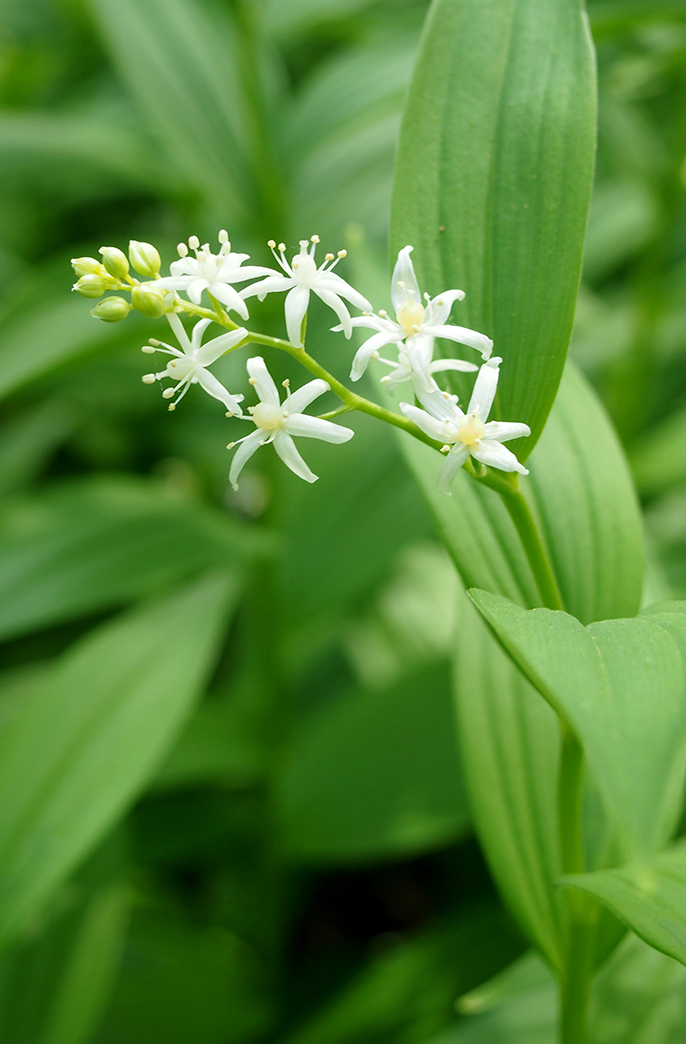
Starry False Solomon’s Seal

One of the best things about a woodland garden is the way shadows, green tones, and soft duff evoke the presence of enchanted creatures just beyond our vision. No plant in our garden supports this dreamlike quality more than Starry False Solomon’s Seal.

Each spring we’re charmed by the emergence of hundreds of tiny green sprouts. The unbranched stems quickly rise to about 12-18 inches tall and start to sparkle with white, star-shaped flowers. As the season progresses the dainty flowers are replaced with green, watermelon striped berries turning to brilliant red and eventually to black. Whether at home or hiking in our local regional parks, we’re always captivated to see its gently arching form spilling down a hillside or brightening a shady hollow.

We were lucky to learn about this California native perennial, Smilacina stellata, at a Tilden Regional Park Botanic Garden plant sale. It’s been spreading by underground roots through the shady parts of our yard for years and continues delight us from early spring until the end of summer when it dies back to the ground.  Irrigated about once a week in the dry season, Starry False Solomon Seal enjoys growing with Yerba Buena, Tellima, Leopard Lilies, and native ferns.

Starry False Solomon Seal would make a good addition to any shady woodland garden in the five-one-oh. Once they take hold, you may even catch a sidelong glimpse of a fairy hiding in their midst.

Sources:
Keator, Glenn; Complete Garden Guide to the Native Perennials of California
Las Pilitas Nursery: Smilacina stellata, False Solomon Seal

How to Reform your Killer Cat

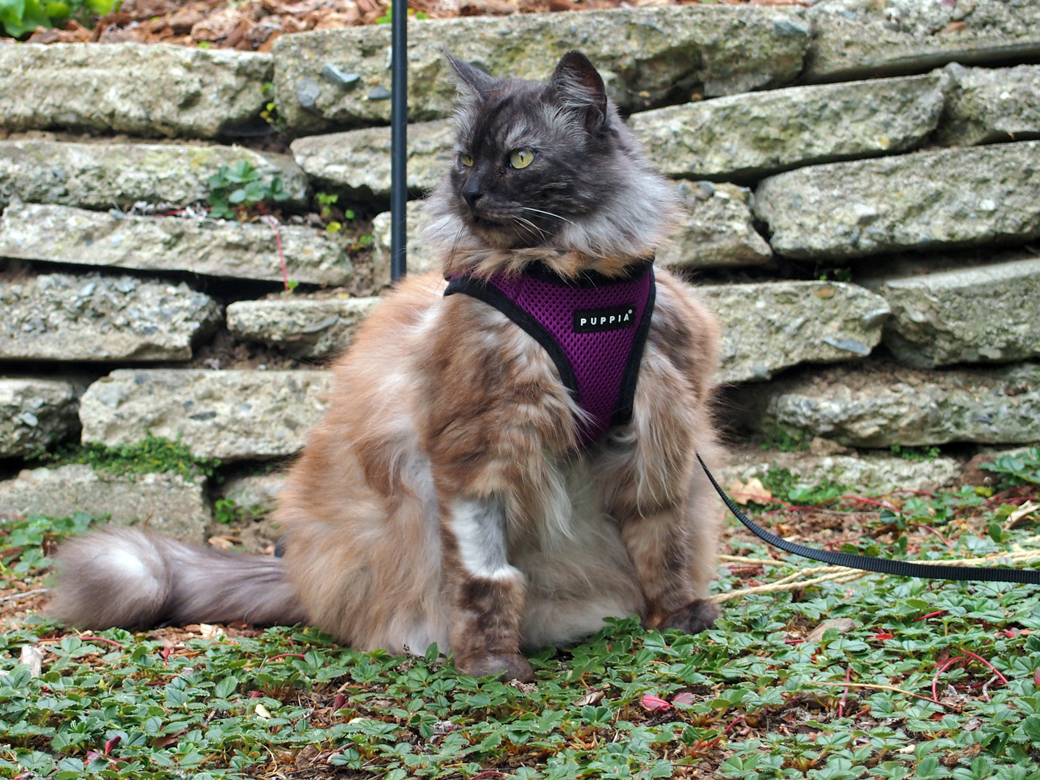
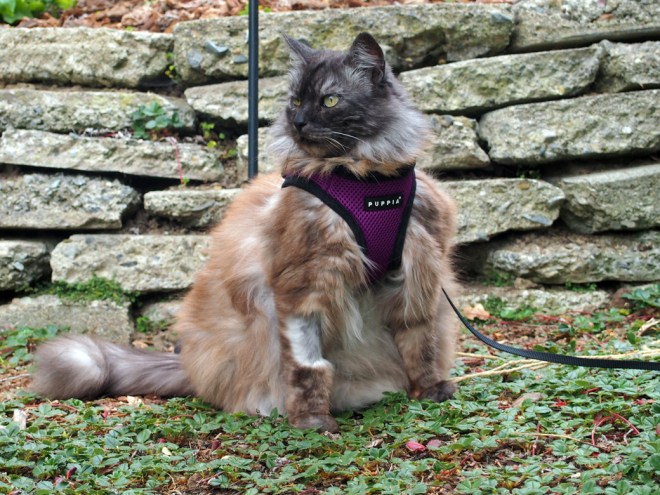
Leashed TheoOur cat wears a harness and a leash when he’s outside. Why? He’s a killer.

I love gardening and Jan loves birds. As soon as we had our own yard, we started to create a habitat garden to attract birds and insects. A couple of years later, an abandoned cat adopted us. At first we tried to run him off the property, but we eventually gave in to his charms, took him in, and named him Theo.
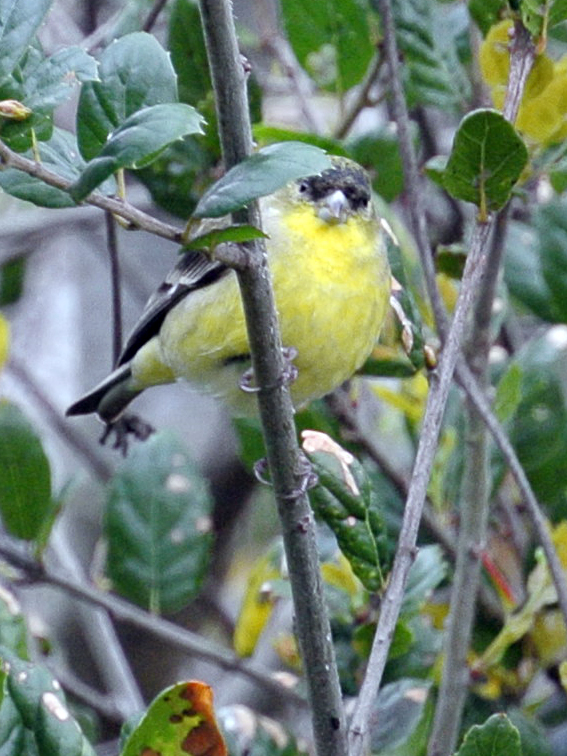
Lesser Gold FinchTheo was used to spending his days outdoors frolicking, so we left him outside while we went to work. We knew we had a conflict of interest in the cat vs. bird department, but thought it was probably okay since he’s a male, and females are generally the hunters of the feline world. Wrong! After the second time he came into the house, bird in mouth, saying “oh, look at the present I have brought for you!” we attached a bell to his collar. This turned out to be about as effective as trying to stop a flood with a box of cotton balls.

We decided the only thing left to do was to keep him in the house all the time, essentially converting our house into a prison … not only for the cat, but for us, too. No longer could we open our doors and windows to the warm air and sweet smells of our own yard. To make things worse, Theo was so distraught at being cooped up that he started tearing the house up, scratching the doors and rugs, and yowling his head off 24/7. The only saving grace was the knowledge that the birds were safe.

Bottom line, no matter how convenient it might be to let your cat out, and no matter how much joy your kitty might get from wandering unfettered through the neighborhood, it’s irresponsible for cat owners to allow their pets to kill birds. And don’t kid yourself – that’s what cats do – for fun! Most of the birds in our yard are native to this region. They belong here. Obviously, the cat does not. Songbirds are disappearing from North America (and the rest of the planet) at an alarming rate. According to an article in National Geographic, “some widespread [bird] species generally thought to be secure have decreased in number as much as 80 percent since 1967, and the 19 others in the report have lost half their populations.” The article lists the causes for this shocking loss of birds as global warming, habitat loss, wind turbines, and cats.
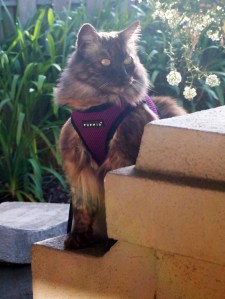
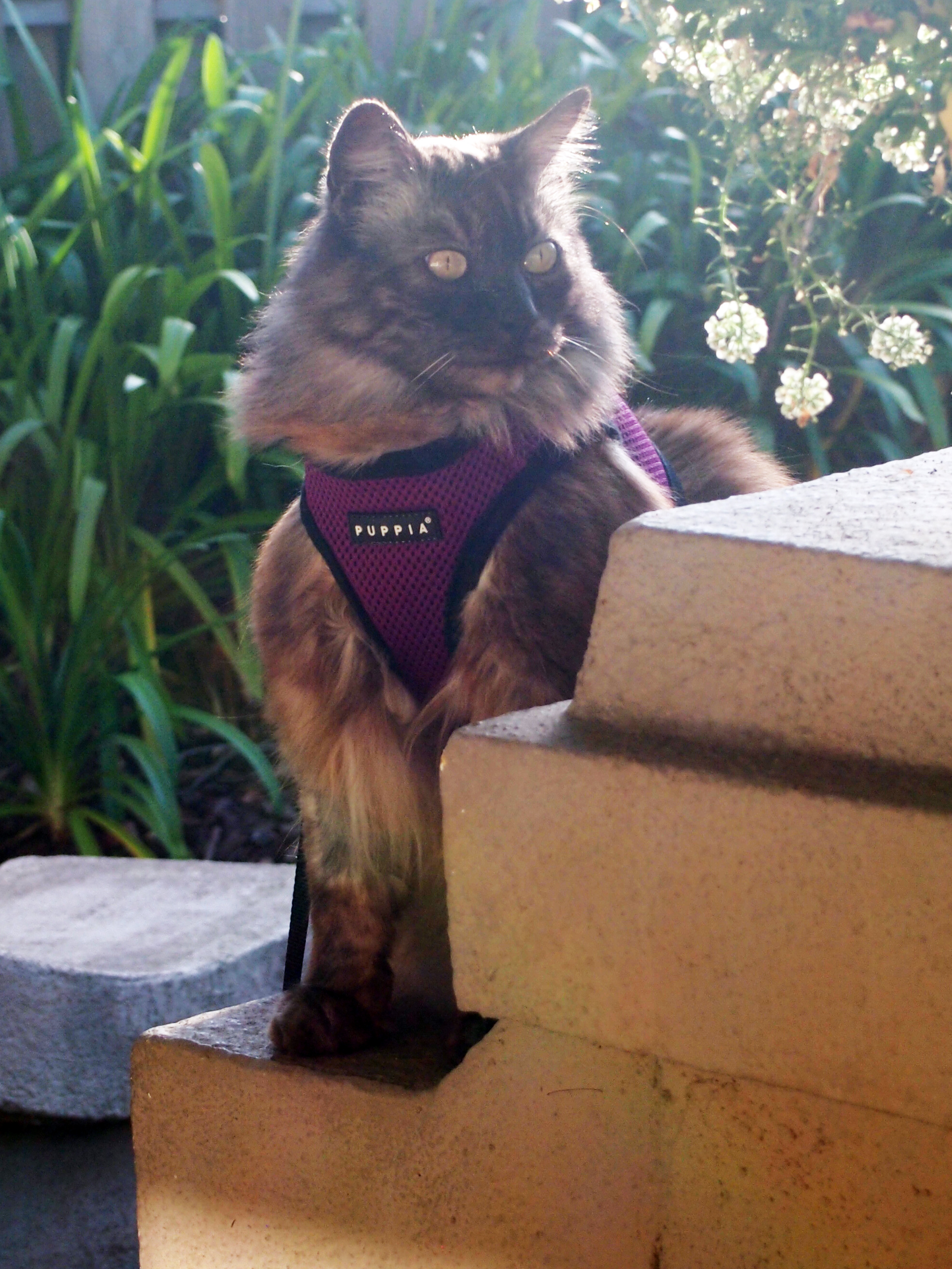
Theo at the porch columnIn her book, the California Wildlife Habitat Garden, Nancy Bauer describes how a homeowner designed a cat run made of redwood planks and wire that connects cat doors in the house to an aerial system of caged walkways through the treetops. Nice-but I’m a designer and this garden is also our habitat. We prefer to keep the beautiful setting we have created. We considered a catio: an enclosed outdoor space where we could trap the cat while we opened the doors and windows. Again, aesthetics trumped comfort. Finally, we came up with the idea of outfitting Theo with a harness and leash.

We bought an inexpensive adjustable cat harness and leash at the pet store and added about 6 additional feet to the leash, using twine. The salesperson cautioned us to stay with the cat when he’s tied up so he doesn’t choke himself. The first time we tried the harness Theo hated it, went a little crazy, and twisted out of it-but it didn’t take long before he caught on. We upgraded to a nicer harness from the dog department because the cheap model tangled his fur. Now, Theo is excited to get into his harness, knowing he’s going outside. We sometimes tie him near the doors so we can see him and have the house open.

Now everybody is able to enjoy the bit of nature outside our doors and the birds are safe from our little killing machine.

TELL US ABOUT IT! Sometimes trying to uphold “the greater good” in your day-to-day life can be impractical at best, or just a flat-out pain in the butt, and it is tempting to fall into the “tragedy of the commons” trap – i.e., I am just one person, so the effect I have overall doesn’t really make a difference. We’d like to hear from you about how you have dealt with these kinds of challenges.

Click on an image below to start a slideshow.

Living Local: Our Own Backyard

New Steps from Above

There’s no place more local than your own backyard. We’re outdoorsy gals and we spend a lot of time both working and relaxing in our yard. When we bought the house, the steep path down to the garden started with wooden steps, leading to a concrete ramp, followed by haphazardly arranged railroad-tie steps, and then a short bare incline to the level terrace at the foot of the slope. It was kind of a mish-mash jumble that we first thought was charmingly rustic and later, well, not so charming.

We have a lot of dreams for our yard, but like most people, we have limited funds so we have to carefully pick and choose what we take on and when. Since the steps are the gateway to our favorite outdoor room, we decided it would be this year’s backyard project.

Before: The original path to the backyard was a steep and uneven mix of ramps, railroad ties, urbanite, and bare slopes.

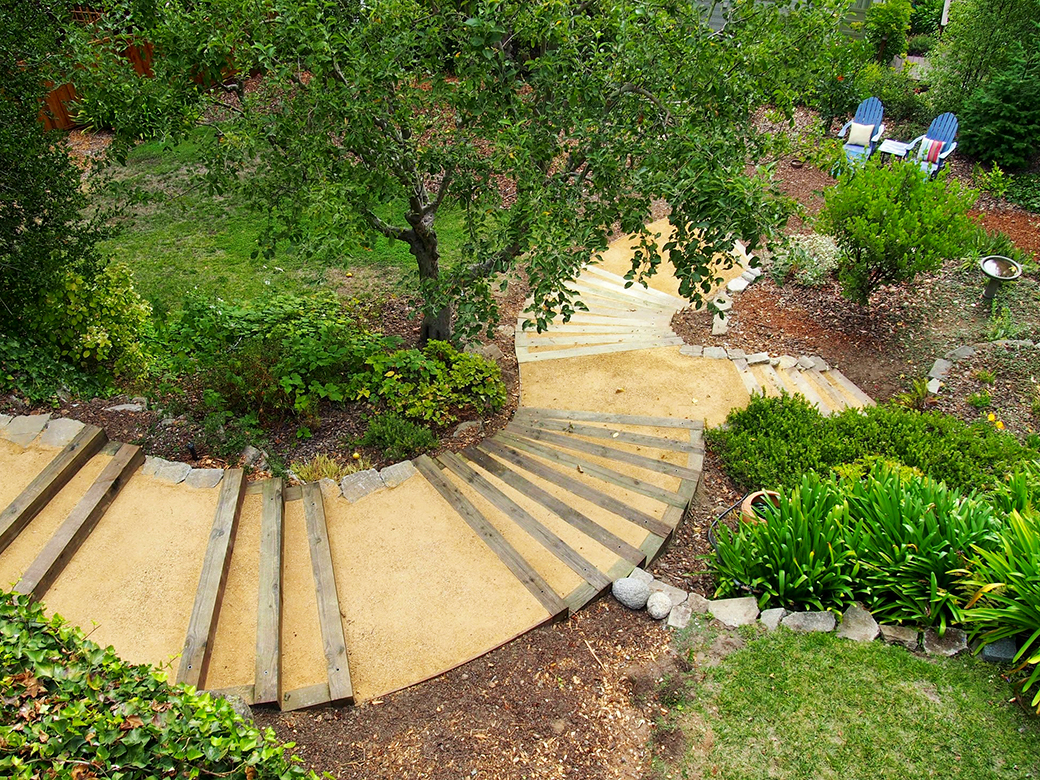
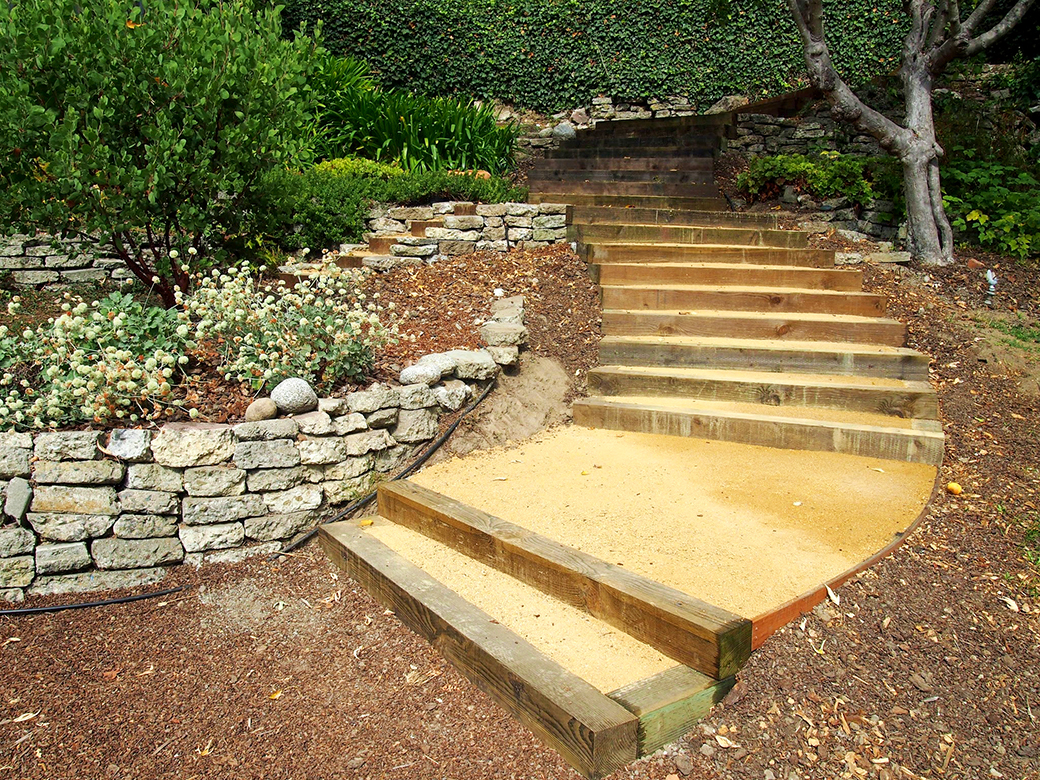
After: The new walkway from our home to the garden is composed of six-foot wide curving steps and level landings. It's astounding how much more of a pleasure it is to walk on a well-designed and built set of steps.
After: The new walkway from our home to the garden is composed of six-foot wide curving steps and level landings. It’s astounding how much more pleasurable it is to walk on a well-designed and built set of steps.

Design/Build
We hired Four Dimensions Landscape Company in Oakland to design and build the steps and we couldn’t be happier with our experience. First, they designed the striking “S” curve on paper, knowing adjustments might be made in the field. The integrated process of design/build makes for a smooth and efficient transition from paper to earth. You wouldn’t want a contractor who doesn’t appreciate design enough to make smart decisions during construction.

When it came time to put the steps in the ground, Michael Thilgen, one of the Company’s owners and a licensed landscape architect, spent hours on-site with a transit and the construction crew. He made sure the steps are comfortable to traverse with landings at the locations where we want future paths to connect. At the same time, he never lost sight of that sinuous line that makes these the steps of our dreams.

Sustainability
The new steps are constructed of landscape timbers, decomposed granite, and existing urbanite (recycled concrete) we had on site. The decomposed granite is permeable for improved storm water infiltration. The original railroad-ties will be reused to make a retaining wall in another part of our yard. Now we spend even more time in the backyard, sprucing it up to be worthy of the new steps.

Have you been working on any projects close to home?

What if it really does rain?

Lake Merritt Green Roof

Lake Merritt Permeable Paving

I have a positive outlook this morning: I’m thinking about what’s going to happen to all that rain we’re going to get this winter in California.

Let’s say we left land in its natural state: much of the stormwater would be held by plants, soak into the soil, or seep slowly downhill. Pollutants washed from the atmosphere would be absorbed through contact with the plants and soil.

But we don’t leave land alone. We build things through which water can’t flow. Roofs and pavement prevent rain from reaching the soil. Water runs off impervious surfaces, and pipes transport it rapidly to creeks and to the Bay.

That creates problems. The water enters the system too fast, causing erosion and increasing the possibility of flooding. Pollutants running off roads and parking lots are discharged into local creeks and eventually into the Bay. Rainwater has fewer opportunities to recharge the groundwater table.

Vegetated swale

The goal of Stormwater Best Management Practices (BMPs) is to make site drainage mimic, as closely as possible, the way a natural landscape drains.

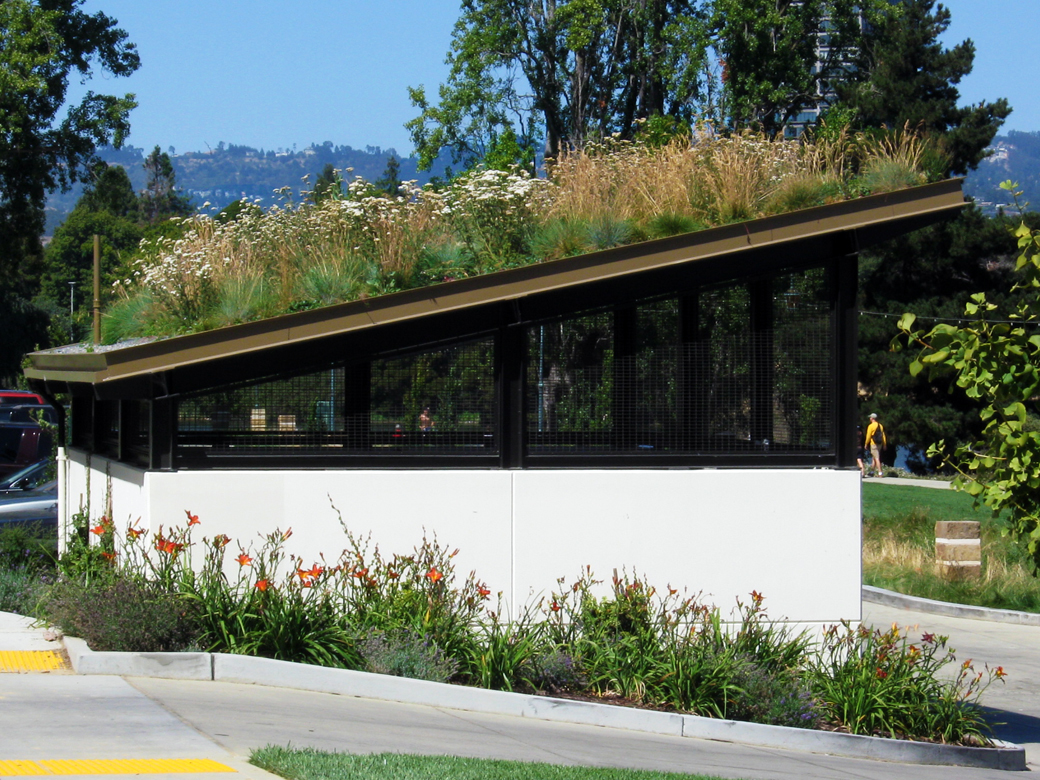
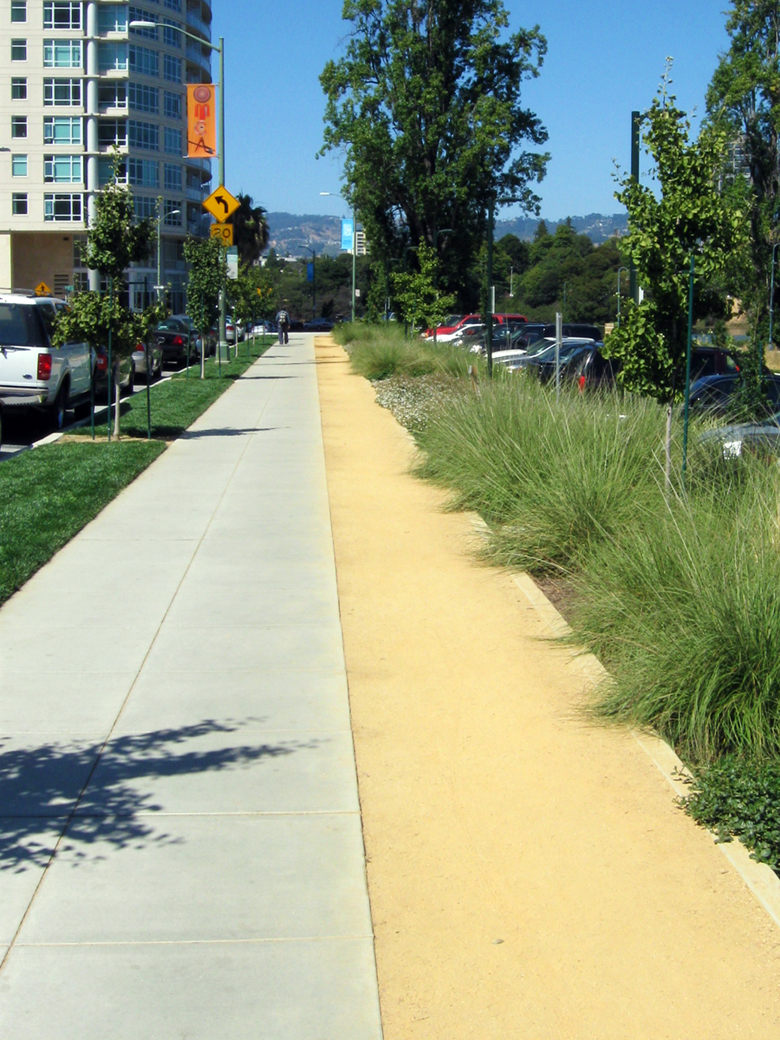
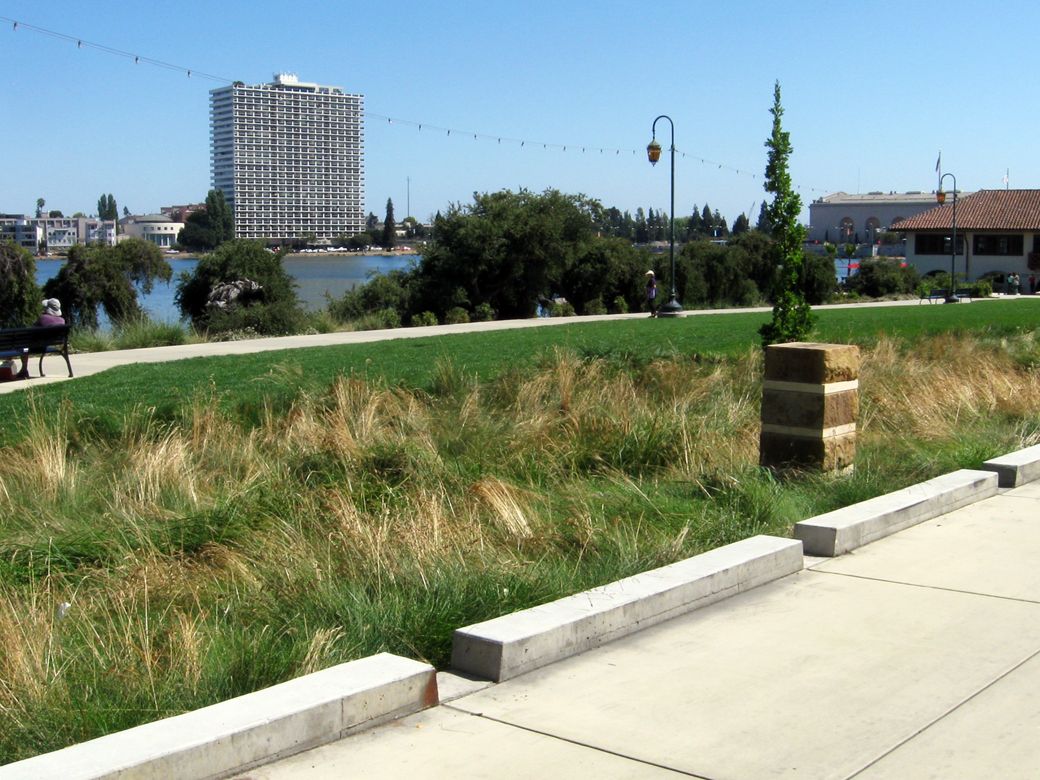
These images show three BMPs used in the Lake Merritt Municipal Boathouse project. The landscape architects for the project were Wallace Roberts & Todd of San Francisco and Adrienne Wong Associates of Oakland.

Green Roof
The green roof over the recycling and trash structure filters pollutants from stormwater, minimizes roof runoff, and reduces heat island effect.

Permeable Paving
The decomposed granite running surface is permeable. Permeable paving allows stormwater to soak into the ground, filtering and storing it.

Vegetated Swale
Openings in the curb allow stormwater to run off the paved surface and into the vegetated swale. The swale slows stormwater while the grasses and soil filter out pollutants before entering the storm drain system.

These stormwater solutions fit beautifully into the landscape. I think that’s because they were part of the designers’ plan from inception. Now, bring on the rain.

What is something you do to save water?

A Truly Local Cocktail

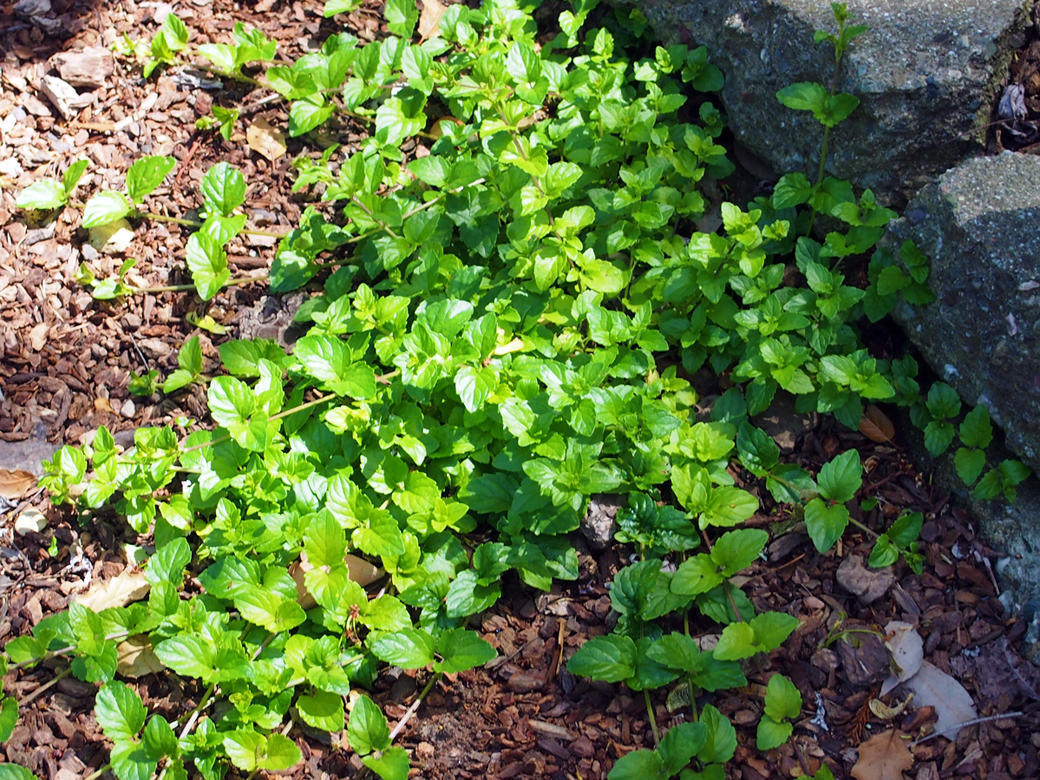
OLYMPUS DIGITAL CAMERASan Francisco was originally named for this plant, Yerba Buena. It means “good herb” in Spanish. The City’s name was changed to San Francisco in 1846. The botanical name for this plant is Satureja douglasii.

As you might imagine, it’s a California native plant. It’s easy to grow, smells delightful, and makes luscious mint juleps.

Yerba Buena Julep Recipe
To mix a truly local cocktail, use a Bay Area-bottled bourbon like B&E (Breaking & Entering) by St. George Spirits in Alameda or, if you’re willing to seriously break with tradition, Old Portrero Rye Whiskey, distilled in San Francisco.

3-4 six-inch long stems of yerba buena leaves
1/2 tablespoon simple syrup
4 ounces whiskey
1 three-inch long stem of yerba buena

Muddle the yerba buena and simple syrup in the bottom of a chilled old-fashioned glass. Fill the glass with ice (crushed is traditional), add the whiskey, and stir until the glass is frosty. Garnish with the yerba buena sprig, extending it above the rim of the glass.

It’s the perfect cocktail for a warm evening, sitting in your garden, listening to the Giants or the A’s game on the radio. Let me know how you like it.

Beach Strawberry

Fragaria chiloiensisThis California native plant, Fragaria chiloiensis, grows quickly in our yard in Oakland. Sometimes it grows too well, spreading into areas intended for less rambunctious native plants. Still, it’s a great groundcover in sun or part shade. It’s more drought tolerant with some shade during part of the day.

The reason why I’m thinking about this plant today, is the following description by Kelly Hardwicke, a senior botanist and pollinator expert at H.T. Harvey & Associates, an ecological consulting firm with whom I’m currently working:

“Fragaria…is one of the most valuable herbaceous caterpillar host genera in North America, providing host opportunities for over 70 native lepidopteran species.”

That means butterflies. Come on over to our yard; we’ve got Fragaria for all.