Why Build a Parklet?

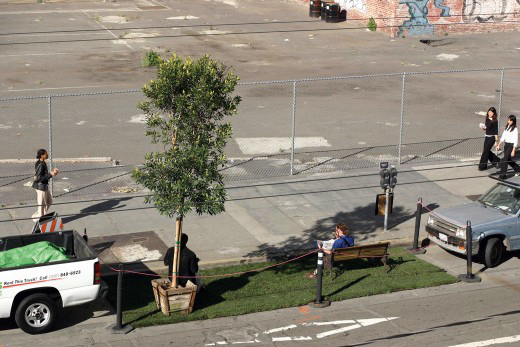
40th St Parklet, Oakland-from streetThey’re called parklets but they’re often more like outdoor café dining areas. These sidewalk extensions are parklets because of their roots. In 2005, the clever folks at ReBar had a plan to take back some of the space reserved for vehicles and turn parking spaces into little parks, or parklets. They can be used for any public use: galleries, bike parking, space to relax, but they are frequently used as café seating.

To take over a couple of parking spaces, most cities require a permit, an annual fee, neighbors’ buy-in, and a decent design. Parklets are privately funded and maintained but they’re public open space and accessible to everyone. You don’t have to buy a cup of coffee to hang out. Parklets are temporary – they exist as long as the host maintains the permit and the city thinks it’s a benefit to the community. As such, parklets are a form of tactical urbanism or urban prototyping. I’ll discuss that movement in a future post.

The remarkable thing about parklets is they are a cost-effective form of placemaking. Everyone wins:

  • The host usually enjoys economic rewards.
  • The city is able to activate streets at little cost.
  • The public benefits from vibrant outdoor spaces.

What more could you ask for? Are parklets popping up in your city? The ones shown here are in my home town: Oakland, California.

Oakland City Center Walk

There-Oakland City CenterCity Center Walk MapThe California Chapter of the American Planning Association (APA) is hosting a conference in Oakland this weekend and I’ll be there. Well, I’ll be here because I live and work in Oakland. I’ve traveled to conferences before and they’re often located in areas that aren’t very walkable. I need my walk. As a result, I wait at crossing signals for ridiculous lengths of time, hike past acres of surface parking lots, and look longingly into dark coffee houses that are closed on weekends.

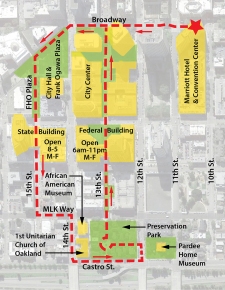
The good news: The conference is located right in the heart of our vibrant downtown and I know my way around. For all Oakland Convention Center visitors this or any weekend, here is an easy 1.25 mile walk designed for you. This route is best enjoyed 8-5, Monday-Friday because it takes you through the lobbies of two impressive public buildings. If you need your walk on the weekend, you can find your way around the blocks. At least the coffee shops will be open.

You needn’t worry about safety when walking in downtown Oakland during daylight hours. I do it every day. Just remember to pay more attention to your surroundings than to your phone and don’t leave your rental car parked on the street at night.

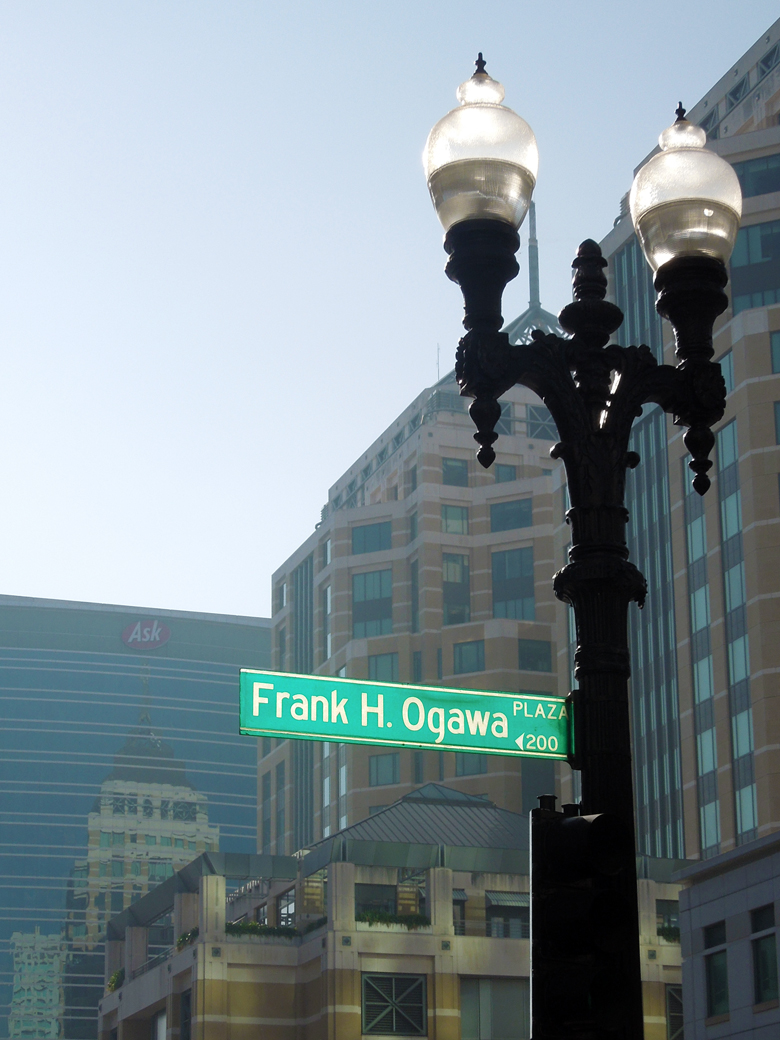
Frank H. Ogawa WayFrank Ogawa Plaza
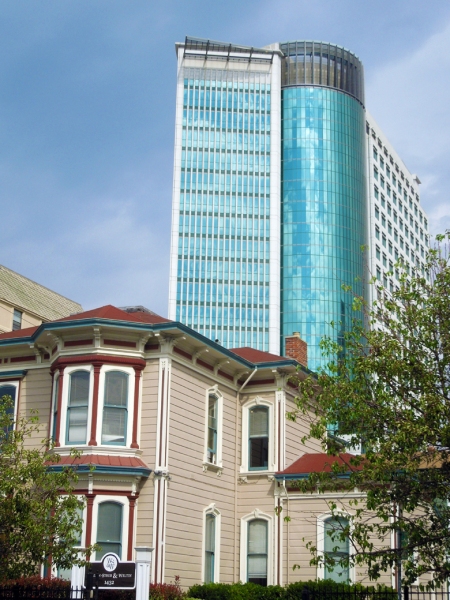
Start walking north up Broadway from the Oakland Convention Center. After crossing 14th Street, make a slight left so you’re walking on the left side of the Lionel Wilson Building (originally the First National Bank Building). Now you’re in Frank Ogawa Plaza, center of all the “Occupy Oakland” hubub a few years ago. As you can see, the lawn has been replaced and the plaza is acting as a true town square. The large coast live oak in the center of the lawn is the Jack London Oak, planted in 1917. Representations of this particular oak can be found all over town, from the city logo to Oaklandish goods. This would be a good time to visit the Oaklandish Store Old Victorian and New State Bldgat 1444 Broadway. The sculpture near San Pablo Street is titled Vitality and was created by Oakland sculptor, Bruce Beasley.
Elihu M. Harris State Office Building
Make a slight left past the raised lawn, and take the walkway on the north side of the City Hall. From here, you catch your first glimpse of the Elihu M. Harris State Office Building. After crossing Clay Street, enter the glass atrium and head out the other side. The colored glass circles in the upper walkway guardrails always make me smile. Continue along 15th Street to Martin Luther King Way where you’ll turn left after crossing the street.

Old Main Oakland LibraryOriginal Oakland Main Library and First Unitarian Church of Oakland
Enjoy views of the tops of downtown high-rises as you walk to 14th Street where you’ll cross the street and turn right. I have a soft spot for Carnegie Libraries. The African American Museum and Library on the corner of 14th and MLK Way was opened in 1902 as the Oakland Main Library. Designed in the Italian Renaissance style by architects Bliss and Faville, it received the second California Carnegie grant of $50,000. As you continue down 14th Street, you’ll find the First Unitarian Church of Oakland, completed in 1891.

Preservation ParkPreservation Park
Turn left at the corner of 14th and Castro Streets and again at 12th Street. Pass through the portal into Preservation Park.This beautiful Victorian neighborhood was saved from demolition by public/private partnerships. The five Victorian homes north of 13th Street are in their original locations and the eleven remaining houses were moved here to save them from demolition when the freeway was constructed. The Parisian fountain in the center of the roundabout was salvaged from another home site in Oakland. Preservation Park is home to non-profit organizations and is available for public and private events. I recommend a stop at 150929 Federal Bldg bridge from 13th-smlthe interpretive exhibit at the MLK entrance to the park.
Ronald V. Dellums Federal Building
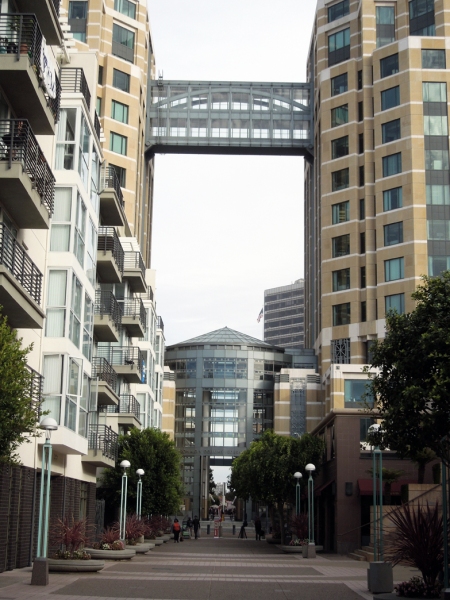
When you arrive at the fountain, you’re at the end of 13th Street which will take you all the way back to Broadway. After crossing MLK Way, the walkway leads you to Three Figures by Stephen De Staebler. The sculptures sit and stand watch over the amphitheater built against the wall of a parking structure. From here, you can see the sky bridge of the Ronald V. Dellums Federal Building. If you’re fortunate to be here on a nice day, the enormous main doors will be open and you can see through them to City Center. If not, City Center with Tribune Bldgmake use of the doors on either side of the rotunda. The lobby is open M-F from 6am until 11pm.

Oakland City Center
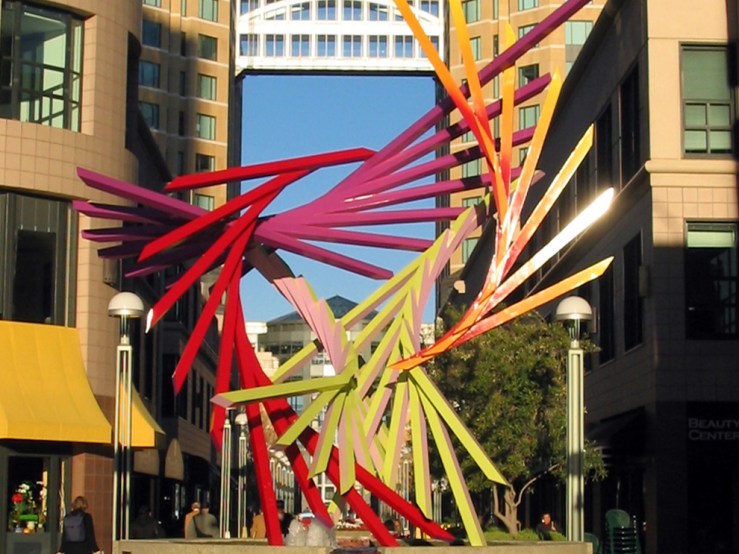
After crossing Clay Street, you’ve arrived in Oakland City Center, a privately owned outdoor retail space with connections to BART, Frank Ogawa Plaza, and the high rise office buildings surrounding it. The sculpture at the center of the space by Roselyn Mazzilli, is titled There, in reference to the often misinterpreted line about Oakland by Gertrude Stein, “There is no there there”. This is one of my regular walks because of the pedestrian focus, the outdoor activity, the art, and the architecture. Much of the area is a product of a redevelopment plan started in the 1960s. It is a vibrant part of the City but I wonder what it would be today if the original street grid, historic apartment buildings, and ground-floor retail were still in place. If you think Downtown Oakland is exciting, read about Uptown Oakland!

Sources:
Frank Ogawa Plaza
Elihu M. Harris State Office Building
African American Museum Library at Oakland
First Unitarian Church of Oakland
Preservation Park
Ronald V. Dellums Federal Building
Oakland City Center

Please click on a photo to start the slideshow.

Uptown Oakland keeps getting better.

Uptown Oakland-Latham SquareNamed a Great Neighborhood by the American Planning Association, Oakland’s Uptown continues to soar. Last Saturday, I took a walk with the California Planning Foundation to find out why. The conversation started with a description of Jerry Brown’s 10K plan, developed when he was mayor of Oakland (1999-2007). His vision was to bring 10,000 new residents to downtown and Jack London Square and renew the historic Arts and Entertainment district in Uptown. As we walked through the neighborhood, we learned about how Oakland made it happen, and saw for ourselves how successfully the plan is playing out.

Uptown Oakland-Fox TheaterYou’ve probably heard about Art Murmur, a giant street party that takes place in Uptown on the First Friday of every month. You’ve likely been to the excellent music venues, restaurants, and night clubs that have been proliferating for the past several years. You’ve noticed the new transit-oriented housing developments, the new Art Park, and even some successful retail businesses like Oaklandish. Here are a few things you may not have known:

OSA
One of our Governor’s ideas was to create two charter schools and bring one of them to Uptown. Before a space was ready, Oakland School for the Arts operated out of a tent, in a parking lot between 18th and 19th Streets adjacent to San Pablo Avenue. Today, it shares a home with the historic Fox Theater. The school is a success story in its own right but it has also enlivened the Uptown neighborhood by bringing youth to the streets, venues, and parks during weekdays.

Oakland Floral Depot Building  & Flora Restaurant
The Oakland Floral Depot building houses the restaurant, Flora.


Historic Preservation

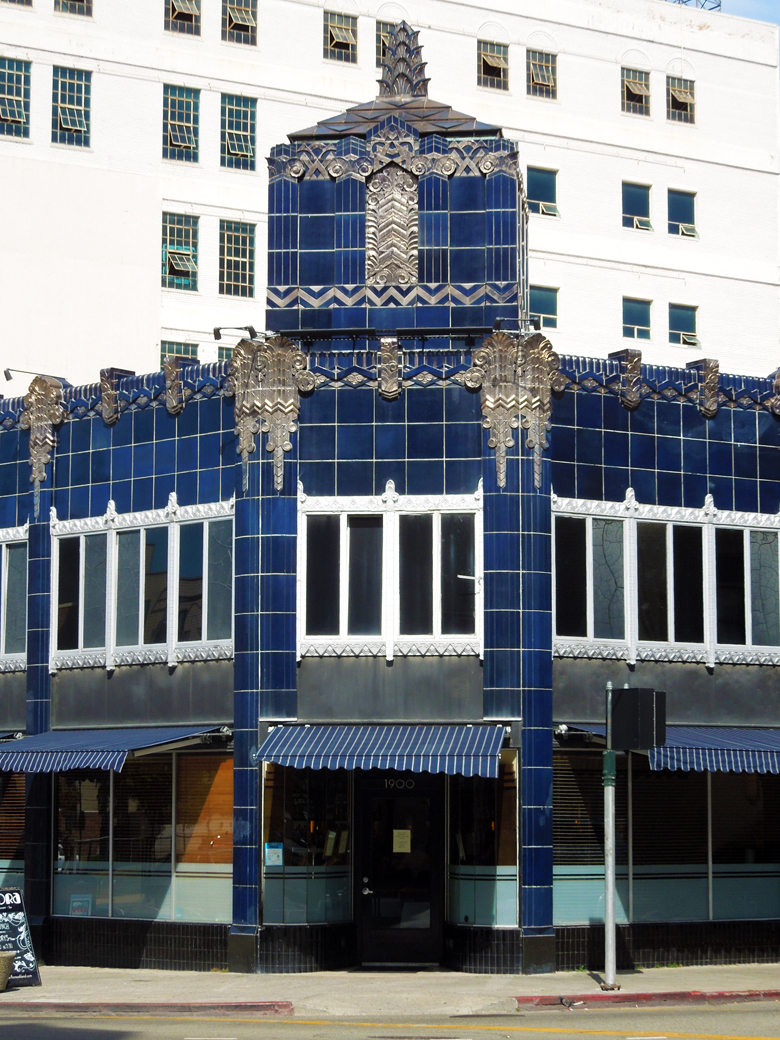
When the Loma Prieta earthquake hit Oakland in 1989, there was little financial incentive to demolish damaged buildings and start over. This turned out to be a boon for the beautiful, historic buildings that have been restored. Lack of interest in Uptown properties gave the Oakland Heritage Alliance and the City a chance to figure out ways to save the original buildings or facades. Many of the buildings are designed in the Art Deco style, and faced with glazed terra-cotta.

The City also provides matching grants to businesses in designated areas to renovate their exteriors. Free architectural assistance and 50 percent matching grants of between $10,000 and $30,000 are available to property and business owners for eligible projects.

The Capwell Building
This is a story of anticipated success. After the earthquake damaged the Beaux-Arts style department store, the retrofit included covering the original windows and terra-cotta cladding with concrete. The building that housed Sears since 1996, was purchased by Lane Partners who began renovation last November. The new design promises to bring back the windows and reopen the interior BART entrance. The ground floor will feature restaurants and foodie retail while the 2nd, 3rd and 4th floors are reserved for tech tenants.

Uptown Bike StationBike Station
A Bike Station has opened up near the 19th Street BART entrance. It has free, attended parking for 130 bikes from 7 am to 9 pm on weekdays. They offer bike repair and tune-ups as well as basic bike accessories. If you have too much fun Uptown to ride your bike home, you can leave it overnight for a $5 fee.

17th Street Gateway
The 17th Street entrance to the 19th Street BART station features new artwork inspired by the Oakland Hills, San Francisco Bay, flashy auto paint, and the blue tile of the station. The sculpture, Shifting Topographies, by Dan Corson, is painted with color-shifting paint that changes hue depending on the angle of the sun. At one end of the station, emergency ventilation shafts are disguised with topographic patterns on blue mirrored glass. Shapes of light are projected on the sculpture at night assuring that this a work of art that never stands still.

Never standing still is a good description of the whole Uptown neighborhood: It just keeps getting better.

Click on a photo to start the slideshow.

Shipping Container Village at The Yard

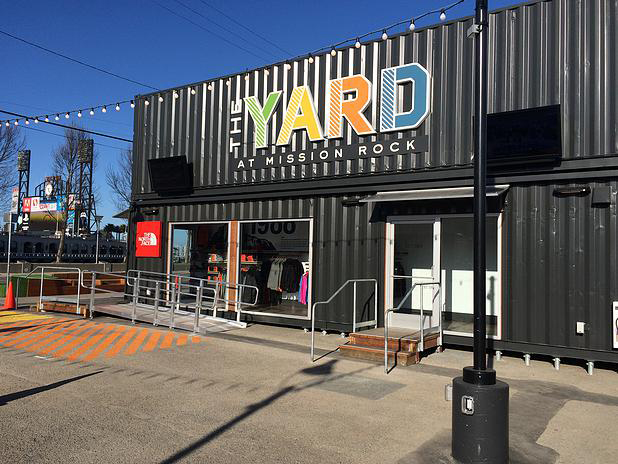
The YardThe Giants are opening a new party pop-up today, across McCovey Cove from AT&T Park. It’s called The Yard. I asked my friend, the designer and manufacturer of the destination’s shipping container buildings, why he wasn’t mentioned in John King’s article in the SF Chronicle. In his South African accent, Jerry commented, “White collars versus blue.”

SF MadeI met Jerry Jameson three years ago when I started working in the building he shares with my employer. He was an architect with a dream of becoming a manufacturer. Jerry doesn’t necessarily take the path of least resistance.

While working on a project for a Silicon Valley firm, I had the pleasure of working directly with Jerry and his business partner, Martha Trela, CEO of their company, UrbanBloc. Jerry designed two shipping container buildings for the outdoor space, a cafe and a restroom. The client decided not to go forward with the project but I was able to get a better idea about what goes into making a building from a shipping container: how to anchor it, make it universally accessible, connect it to the sanitary sewer, and a thousand other issues I wouldn’t normally have considered.

Bike ShopUrbanBloc opened a manufacturing plant here, in the East Bay, and I didn’t see Jerry for a couple of months while he and his team built the modular units for The Yard. I’d have loved seeing the trucks carrying the buildings across the Bay Bridge. The schedule was so tight, they built a sleeping room in the plant where they could grab 3-4 hours of sleep while working around the clock. They lived like this for nine weeks. Jerry said it was the hardest thing he’s ever done.

It’s a remarkable thing. There’s no good reason for UrbanBloc to slide under San Francisco’s design radar but now there’s another good reason to go to a Giants game.

Photo Sources:
http://www.urbanbloc.net
http://insidescoopsf.sfgate.com/blog/2015/03/18/what-to-eat-and-drink-at-the-yard-at-mission-rock-opening-this-week
http://www.sfchronicle.com/bayarea/place/article/Urban-chic-shipping-pods-catch-on-in-Giants-6140692.php

I’d love to hear what you think.

Placemaking

Parking Day in Flint, Michigan
Parking Day in Flint, Michigan. Photo from http://www.aiaflint.com/
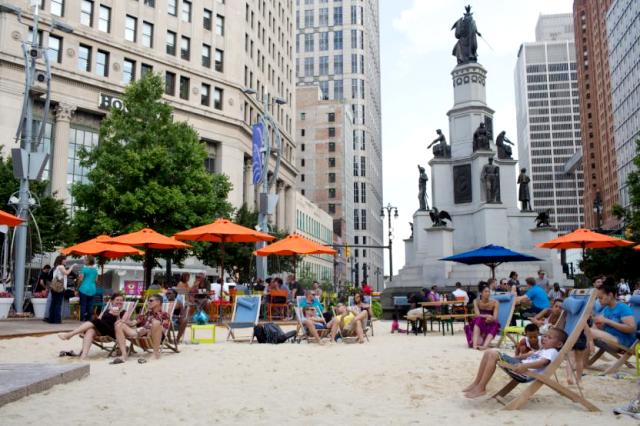
In downtown Detroit, an underutilized lawn was transformed into a beach at Campus Martius Park. Photo from pps.org

I’ve been posting about all things local here in the East Bay. What about you and the place where you live? What do you love about your neighborhood? What would make it even better?

On Friday, I attended the SF Placemaking Summit at AIASF (American Institute of Architects, San Francisco Chapter).The overall idea of placemaking is to create better public spaces: not just better looking, but open space that’s more useable by everybody in the community. Some of the principles are:

  • The community is the expert.
  • Public space should be an authentic reflection of the community.
  • Do little, easy things now and you can improve it if it’s working.
  • Public spaces are for everyone.
  • Each place should have several things to do.
  • Great public spaces are places to connect.

How is that different from good urban design? In my opinion, it isn’t. That may be an effect, in part, of the placemaking movement’s influence on urban design and the inspiration of William H. Whyte. In the 1970s, Whyte set up the Streetlife Project,a pioneering study of how people use spaces. Over the past 30 years, urban designers have learned to incorporate the principles of placemaking in our work.

The original PARK(ing) Day park created by Rebar in 2005. Photo from Rebar

An important placemaking concept is a bottom-up approach, and parklets are an example inspired by PARK(ing) Day. Downtown San Francisco is densely populated and built-out with limited room for new public open space, but there’s plenty of space dedicated to the automobile. Rebar, a local art and design studio, started PARK(ing) Day in San Francisco in 2005 by converting a single metered parking space into a temporary public park.The concept was so popular that now PARK(ing) Day is celebrated on the third Friday in September all over the world. Drawing on the success of PARK(ing) Day, the City of SF’s Planning Department adopted a policy for parklets that would last an entire summer or longer: Pavement to Parks. This has been the model for global parking space conversion to useable open space.

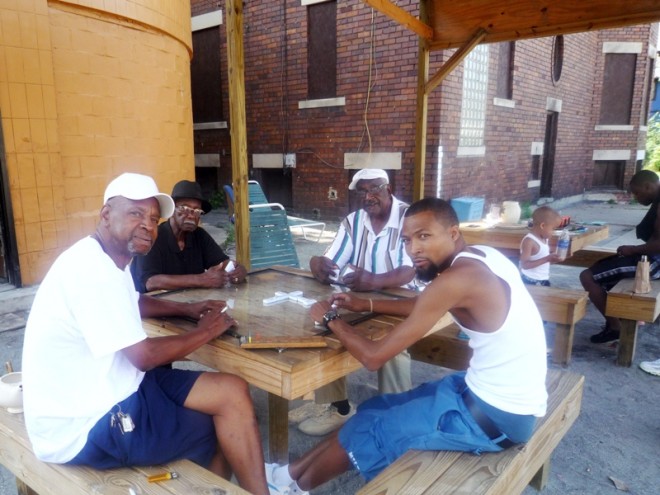
Central Detroit residents have transformed an abandoned gas station into a gathering place at Peaches & Greens, complete with new furniture and a pavilion structure to protect domino players from the elements. / Photo: Steve Davies / Peaches & Greens
Central Detroit residents transformed an abandoned gas station into a gathering place at Peaches & Greens. Photo: Steve Davies/Peaches & Greens

The SF Placemaking Summit was thought-provoking and inspirational. We asked a lot of questions that I’ll explore here in the coming weeks. For example, a lot of the placemaking happening in San Francisco is designed for hipsters. What kind of placemaking is for children or seniors? Are public spaces being created in all neighborhoods?

Parklets are just one way you might be able to create public space in your community. What are some others? Have you been noticing more outdoor places to gather in your town? Let’s start a conversation.

Sources: http://www.pps.org/