They’re called parklets but they’re often more like outdoor café dining areas. These sidewalk extensions are parklets because of their roots. In 2005, the clever folks at ReBar had a plan to take back some of the space reserved for vehicles and turn parking spaces into little parks, or parklets. They can be used for any public use: galleries, bike parking, space to relax, but they are frequently used as café seating.
To take over a couple of parking spaces, most cities require a permit, an annual fee, neighbors’ buy-in, and a decent design. Parklets are privately funded and maintained but they’re public open space and accessible to everyone. You don’t have to buy a cup of coffee to hang out. Parklets are temporary – they exist as long as the host maintains the permit and the city thinks it’s a benefit to the community. As such, parklets are a form of tactical urbanism or urban prototyping. I’ll discuss that movement in a future post.
The remarkable thing about parklets is they are a cost-effective form of placemaking. Everyone wins:
The host usually enjoys economic rewards.
The city is able to activate streets at little cost.
The public benefits from vibrant outdoor spaces.
What more could you ask for? Are parklets popping up in your city? The ones shown here are in my home town: Oakland, California.
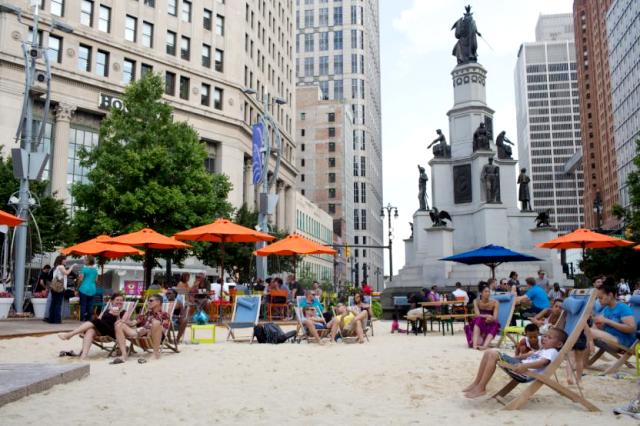
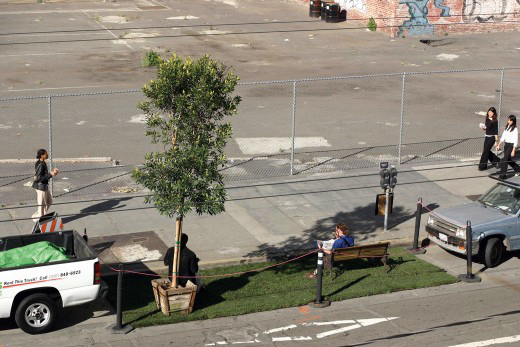
Parking Day in Flint, Michigan. Photo from http://www.aiaflint.com/In downtown Detroit, an underutilized lawn was transformed into a beach at Campus Martius Park. Photo from pps.org
I’ve been posting about all things local here in the East Bay. What about you and the place where you live? What do you love about your neighborhood? What would make it even better?
On Friday, I attended the SF Placemaking Summit at AIASF (American Institute of Architects, San Francisco Chapter).The overall idea of placemaking is to create better public spaces: not just better looking, but open space that’s more useable by everybody in the community. Some of the principles are:
The community is the expert.
Public space should be an authentic reflection of the community.
Do little, easy things now and you can improve it if it’s working.
Public spaces are for everyone.
Each place should have several things to do.
Great public spaces are places to connect.
How is that different from good urban design? In my opinion, it isn’t. That may be an effect, in part, of the placemaking movement’s influence on urban design and the inspiration of William H. Whyte. In the 1970s, Whyte set up the Streetlife Project,a pioneering study of how people use spaces. Over the past 30 years, urban designers have learned to incorporate the principles of placemaking in our work.
The original PARK(ing) Day park created by Rebar in 2005. Photo from Rebar
An important placemaking concept is a bottom-up approach, and parklets are an example inspired by PARK(ing) Day. Downtown San Francisco is densely populated and built-out with limited room for new public open space, but there’s plenty of space dedicated to the automobile. Rebar, a local art and design studio, started PARK(ing) Day in San Francisco in 2005 by converting a single metered parking space into a temporary public park.The concept was so popular that now PARK(ing) Day is celebrated on the third Friday in September all over the world. Drawing on the success of PARK(ing) Day, the City of SF’s Planning Department adopted a policy for parklets that would last an entire summer or longer: Pavement to Parks. This has been the model for global parking space conversion to useable open space.
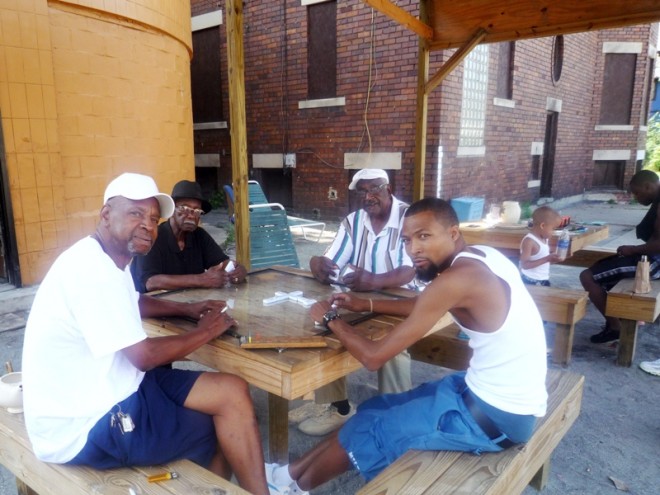
Central Detroit residents transformed an abandoned gas station into a gathering place at Peaches & Greens. Photo: Steve Davies/Peaches & Greens
The SF Placemaking Summit was thought-provoking and inspirational. We asked a lot of questions that I’ll explore here in the coming weeks. For example, a lot of the placemaking happening in San Francisco is designed for hipsters. What kind of placemaking is for children or seniors? Are public spaces being created in all neighborhoods?
Parklets are just one way you might be able to create public space in your community. What are some others? Have you been noticing more outdoor places to gather in your town? Let’s start a conversation.
 They’re called parklets but they’re often more like outdoor café dining areas. These sidewalk extensions are parklets because of their roots. In 2005, the clever folks at ReBar had a plan to take back some of the space reserved for vehicles and turn parking spaces into little parks, or parklets. They can be used for any public use: galleries, bike parking, space to relax, but they are frequently used as café seating.