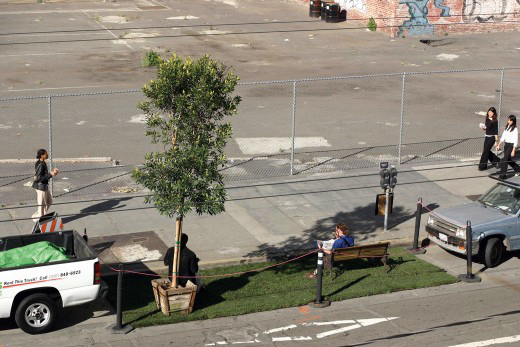
They’re called parklets but they’re often more like outdoor café dining areas. These sidewalk extensions are parklets because of their roots. In 2005, the clever folks at ReBar had a plan to take back some of the space reserved for vehicles and turn parking spaces into little parks, or parklets. They can be used for any public use: galleries, bike parking, space to relax, but they are frequently used as café seating.
To take over a couple of parking spaces, most cities require a permit, an annual fee, neighbors’ buy-in, and a decent design. Parklets are privately funded and maintained but they’re public open space and accessible to everyone. You don’t have to buy a cup of coffee to hang out. Parklets are temporary – they exist as long as the host maintains the permit and the city thinks it’s a benefit to the community. As such, parklets are a form of tactical urbanism or urban prototyping. I’ll discuss that movement in a future post.
The remarkable thing about parklets is they are a cost-effective form of placemaking. Everyone wins:
The host usually enjoys economic rewards.
The city is able to activate streets at little cost.
The public benefits from vibrant outdoor spaces.
What more could you ask for? Are parklets popping up in your city? The ones shown here are in my home town: Oakland, California.
Named a Great Neighborhood by the American Planning Association, Oakland’s Uptown continues to soar. Last Saturday, I took a walk with the California Planning Foundation to find out why. The conversation started with a description of Jerry Brown’s 10K plan, developed when he was mayor of Oakland (1999-2007). His vision was to bring 10,000 new residents to downtown and Jack London Square and renew the historic Arts and Entertainment district in Uptown. As we walked through the neighborhood, we learned about how Oakland made it happen, and saw for ourselves how successfully the plan is playing out.
You’ve probably heard about Art Murmur, a giant street party that takes place in Uptown on the First Friday of every month. You’ve likely been to the excellent music venues, restaurants, and night clubs that have been proliferating for the past several years. You’ve noticed the new transit-oriented housing developments, the new Art Park, and even some successful retail businesses like Oaklandish. Here are a few things you may not have known:
OSA
One of our Governor’s ideas was to create two charter schools and bring one of them to Uptown. Before a space was ready, Oakland School for the Arts operated out of a tent, in a parking lot between 18th and 19th Streets adjacent to San Pablo Avenue. Today, it shares a home with the historic Fox Theater. The school is a success story in its own right but it has also enlivened the Uptown neighborhood by bringing youth to the streets, venues, and parks during weekdays.
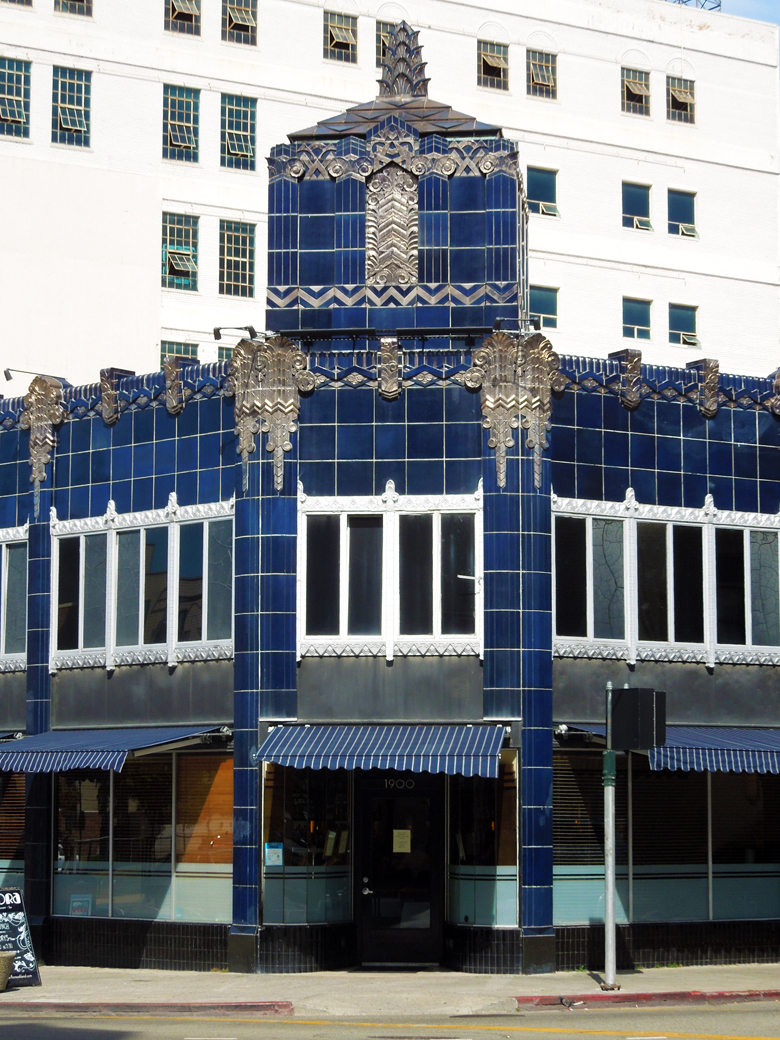
The Oakland Floral Depot building houses the restaurant, Flora.
Historic Preservation
When the Loma Prieta earthquake hit Oakland in 1989, there was little financial incentive to demolish damaged buildings and start over. This turned out to be a boon for the beautiful, historic buildings that have been restored. Lack of interest in Uptown properties gave the Oakland Heritage Alliance and the City a chance to figure out ways to save the original buildings or facades. Many of the buildings are designed in the Art Deco style, and faced with glazed terra-cotta.
The City also provides matching grants to businesses in designated areas to renovate their exteriors. Free architectural assistance and 50 percent matching grants of between $10,000 and $30,000 are available to property and business owners for eligible projects.
The Capwell Building
This is a story of anticipated success. After the earthquake damaged the Beaux-Arts style department store, the retrofit included covering the original windows and terra-cotta cladding with concrete. The building that housed Sears since 1996, was purchased by Lane Partners who began renovation last November. The new design promises to bring back the windows and reopen the interior BART entrance. The ground floor will feature restaurants and foodie retail while the 2nd, 3rd and 4th floors are reserved for tech tenants.
Bike Station
A Bike Station has opened up near the 19th Street BART entrance. It has free, attended parking for 130 bikes from 7 am to 9 pm on weekdays. They offer bike repair and tune-ups as well as basic bike accessories. If you have too much fun Uptown to ride your bike home, you can leave it overnight for a $5 fee.
17th Street Gateway The 17th Street entrance to the 19th Street BART station features new artwork inspired by the Oakland Hills, San Francisco Bay, flashy auto paint, and the blue tile of the station. The sculpture, Shifting Topographies, by Dan Corson, is painted with color-shifting paint that changes hue depending on the angle of the sun. At one end of the station, emergency ventilation shafts are disguised with topographic patterns on blue mirrored glass. Shapes of light are projected on the sculpture at night assuring that this a work of art that never stands still.
Never standing still is a good description of the whole Uptown neighborhood: It just keeps getting better.
Density, diversity, and being part of a larger urban context enlivens Oakland and other Bay Area Cities and makes them exciting places to live and visit. Saturday, Jan and I skipped the Grand Lake Farmers Market and chose to walk around the lake, enjoy an exhibit at the museum, and pick up some take-out Asian food for dinner. So what? Even ordinary activities can be extraordinary in a vibrant city.
It was raining on and off, and I decided I didn’t really need to bring my camera along. Great idea. There’s never anything interesting going on in Oakland. Remind me to always bring a camera, or a phone, or something with which to shoot a bloody photo.
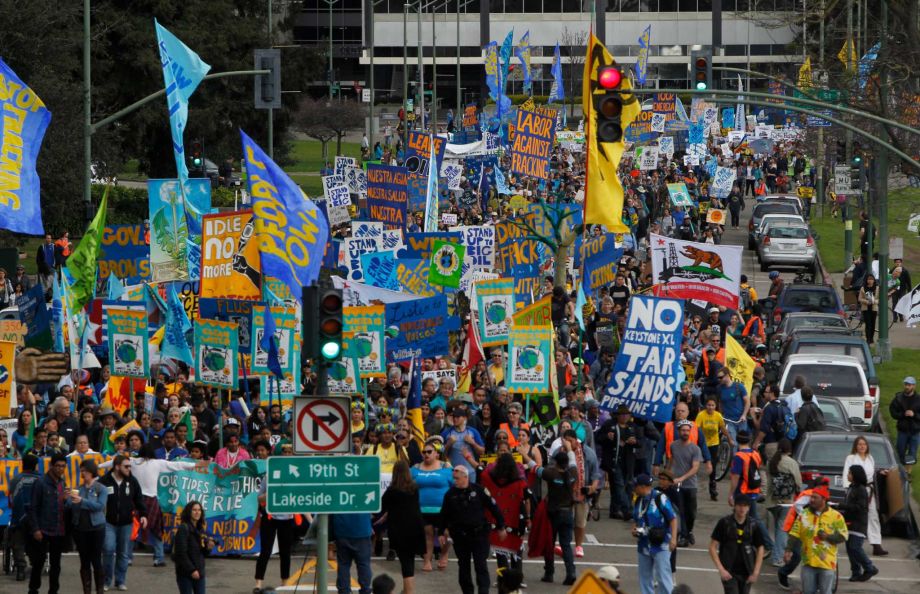
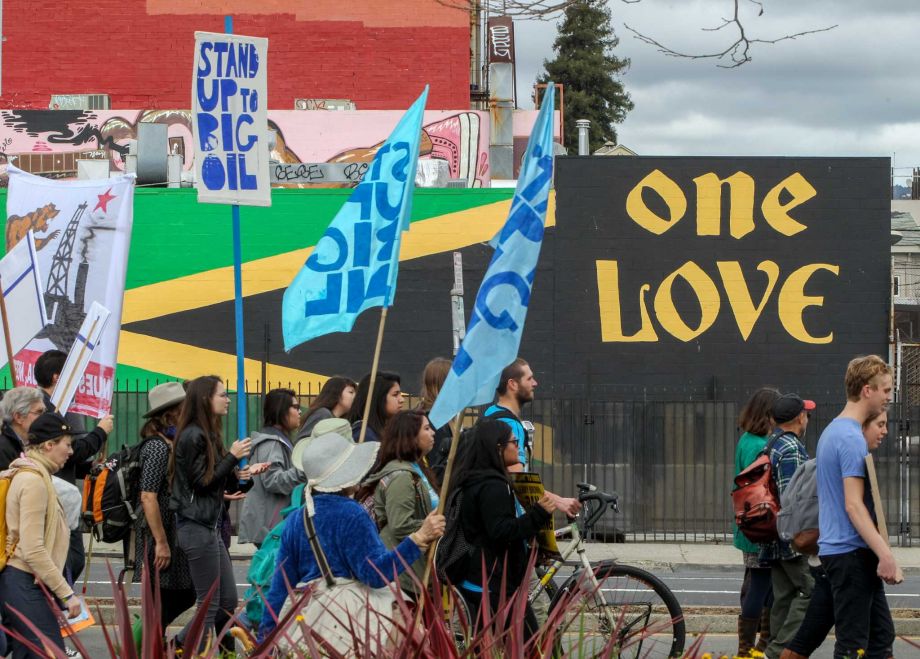
Anti-Fracking Demonstration We were about five minutes into the walk when we noticed thousands of demonstrators heading in our direction. Before we could read their banners, Jan remembered that an anti-fracking march was scheduled for Saturday. I know you know what hydraulic fracturing (fracking) is, but I can’t resist describing it: Frackers drill deep into the earth to inject a huge amount of fluid at high enough pressure to fracture subterranean rocks and release oil or natural gas for our consumption. Even without all the facts, does that sound like a good idea? I don’t think so.
The protest was held in Oakland because Governor Jerry Brown makes his home here and the point of the march was to beseech him to change his policies on fracking. My hypothesis is the demonstration was also held in Oakland because this town is known for being sympathetic to environmental causes and for being able to draw from nearby communities who feel the same. Energized communities have personality.
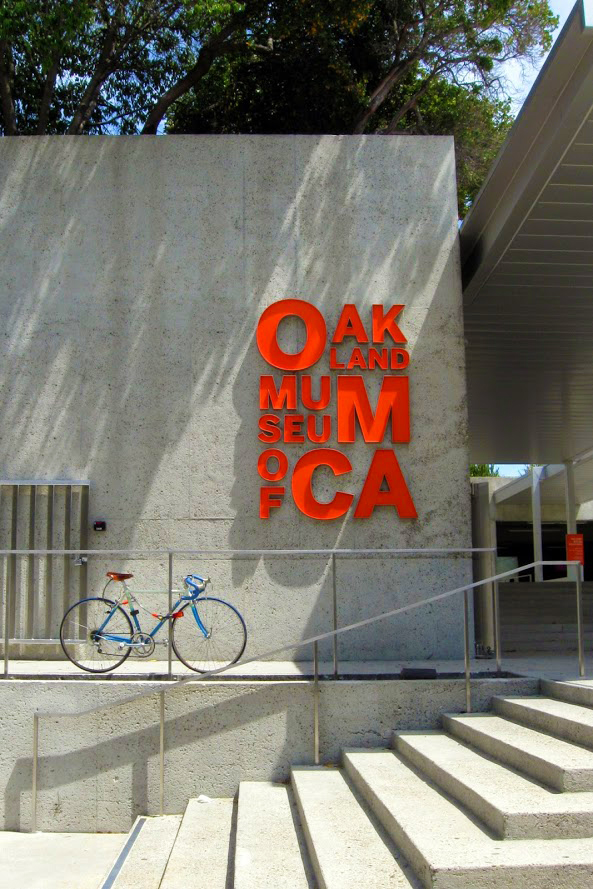
Oakland Museum of California
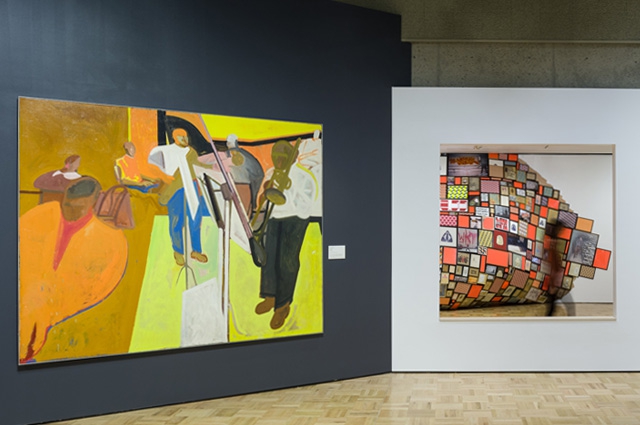
After converging with the crowd at the southern end of the lake, we headed further south to the Oakland Museum of California (OMCA) to check out the exhibit: Fertile Ground: Art and Community in California. Now, I’m one of those oafs who doesn’t like spending more than an hour or so at a time in a museum – but I really like that first hour. That’s one of the reasons a museum membership works for me. We support our local museum and get to stop in whenever we want.
Fertile Ground features the California collections of both SFMOMA (San Francisco Museum of Modern Art) and OMCA. The exhibit guides us through four creative communities active in Northern California from the 1930s to the present:
The San Francisco New Deal Muralists lead by Diego Rivera (1930s)
Postwar at the California School of Fine Arts (1940s-50s)
The New Art Department at UC Davis (1960s-1970s)
The Mission Scene (1990s-Today)
It was a stunning and educational hour. The art is rich with diversity and the high-quality venue makes sense in a an urban location that draws users from around the Bay.
Lin Jia Asian Kitchen
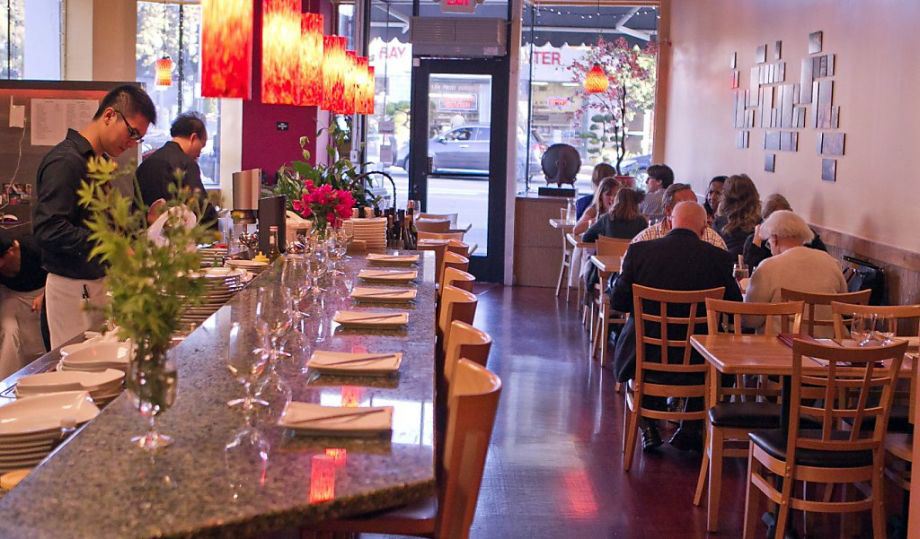
After leaving the museum, we completed our lake loop and ended up on Lakeshore Avenue at Lin Jia Asian Kitchen. You might think it would make sense to call in our order before we arrive at the restaurant, (even though you know I didn’t bring my phone with me – if I did, I could have taken some photos) but that would deprive us of the opportunity to watch the chefs prepare our meal. We like to sit at the bar overlooking the kitchen, order a couple of Tsingtaos when we order the food, and watch the woks in action. We appreciate the high-quality, organic, and sustainable ingredients as well as the excellent preparation. In his review, Michael Bauer describes the experience as, “telling the story of one family’s move from Asia to America.” We’re sure glad they’re here. We’re sure glad we’re here.
As an urban designer, I want to make better places, but some places are lively without help from designers. They evolve into vibrant places with the help of their culturally rich communities. Any thoughts on what makes a great place to live?
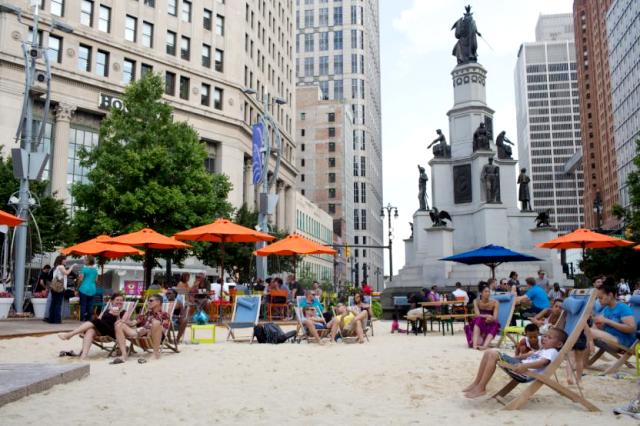
Parking Day in Flint, Michigan. Photo from http://www.aiaflint.com/In downtown Detroit, an underutilized lawn was transformed into a beach at Campus Martius Park. Photo from pps.org
I’ve been posting about all things local here in the East Bay. What about you and the place where you live? What do you love about your neighborhood? What would make it even better?
On Friday, I attended the SF Placemaking Summit at AIASF (American Institute of Architects, San Francisco Chapter).The overall idea of placemaking is to create better public spaces: not just better looking, but open space that’s more useable by everybody in the community. Some of the principles are:
The community is the expert.
Public space should be an authentic reflection of the community.
Do little, easy things now and you can improve it if it’s working.
Public spaces are for everyone.
Each place should have several things to do.
Great public spaces are places to connect.
How is that different from good urban design? In my opinion, it isn’t. That may be an effect, in part, of the placemaking movement’s influence on urban design and the inspiration of William H. Whyte. In the 1970s, Whyte set up the Streetlife Project,a pioneering study of how people use spaces. Over the past 30 years, urban designers have learned to incorporate the principles of placemaking in our work.
The original PARK(ing) Day park created by Rebar in 2005. Photo from Rebar
An important placemaking concept is a bottom-up approach, and parklets are an example inspired by PARK(ing) Day. Downtown San Francisco is densely populated and built-out with limited room for new public open space, but there’s plenty of space dedicated to the automobile. Rebar, a local art and design studio, started PARK(ing) Day in San Francisco in 2005 by converting a single metered parking space into a temporary public park.The concept was so popular that now PARK(ing) Day is celebrated on the third Friday in September all over the world. Drawing on the success of PARK(ing) Day, the City of SF’s Planning Department adopted a policy for parklets that would last an entire summer or longer: Pavement to Parks. This has been the model for global parking space conversion to useable open space.
Central Detroit residents transformed an abandoned gas station into a gathering place at Peaches & Greens. Photo: Steve Davies/Peaches & Greens
The SF Placemaking Summit was thought-provoking and inspirational. We asked a lot of questions that I’ll explore here in the coming weeks. For example, a lot of the placemaking happening in San Francisco is designed for hipsters. What kind of placemaking is for children or seniors? Are public spaces being created in all neighborhoods?
Parklets are just one way you might be able to create public space in your community. What are some others? Have you been noticing more outdoor places to gather in your town? Let’s start a conversation.
 They’re called parklets but they’re often more like outdoor café dining areas. These sidewalk extensions are parklets because of their roots. In 2005, the clever folks at ReBar had a plan to take back some of the space reserved for vehicles and turn parking spaces into little parks, or parklets. They can be used for any public use: galleries, bike parking, space to relax, but they are frequently used as café seating.