Uptown Oakland keeps getting better.

Uptown Oakland-Latham SquareNamed a Great Neighborhood by the American Planning Association, Oakland’s Uptown continues to soar. Last Saturday, I took a walk with the California Planning Foundation to find out why. The conversation started with a description of Jerry Brown’s 10K plan, developed when he was mayor of Oakland (1999-2007). His vision was to bring 10,000 new residents to downtown and Jack London Square and renew the historic Arts and Entertainment district in Uptown. As we walked through the neighborhood, we learned about how Oakland made it happen, and saw for ourselves how successfully the plan is playing out.

Uptown Oakland-Fox TheaterYou’ve probably heard about Art Murmur, a giant street party that takes place in Uptown on the First Friday of every month. You’ve likely been to the excellent music venues, restaurants, and night clubs that have been proliferating for the past several years. You’ve noticed the new transit-oriented housing developments, the new Art Park, and even some successful retail businesses like Oaklandish. Here are a few things you may not have known:

OSA
One of our Governor’s ideas was to create two charter schools and bring one of them to Uptown. Before a space was ready, Oakland School for the Arts operated out of a tent, in a parking lot between 18th and 19th Streets adjacent to San Pablo Avenue. Today, it shares a home with the historic Fox Theater. The school is a success story in its own right but it has also enlivened the Uptown neighborhood by bringing youth to the streets, venues, and parks during weekdays.
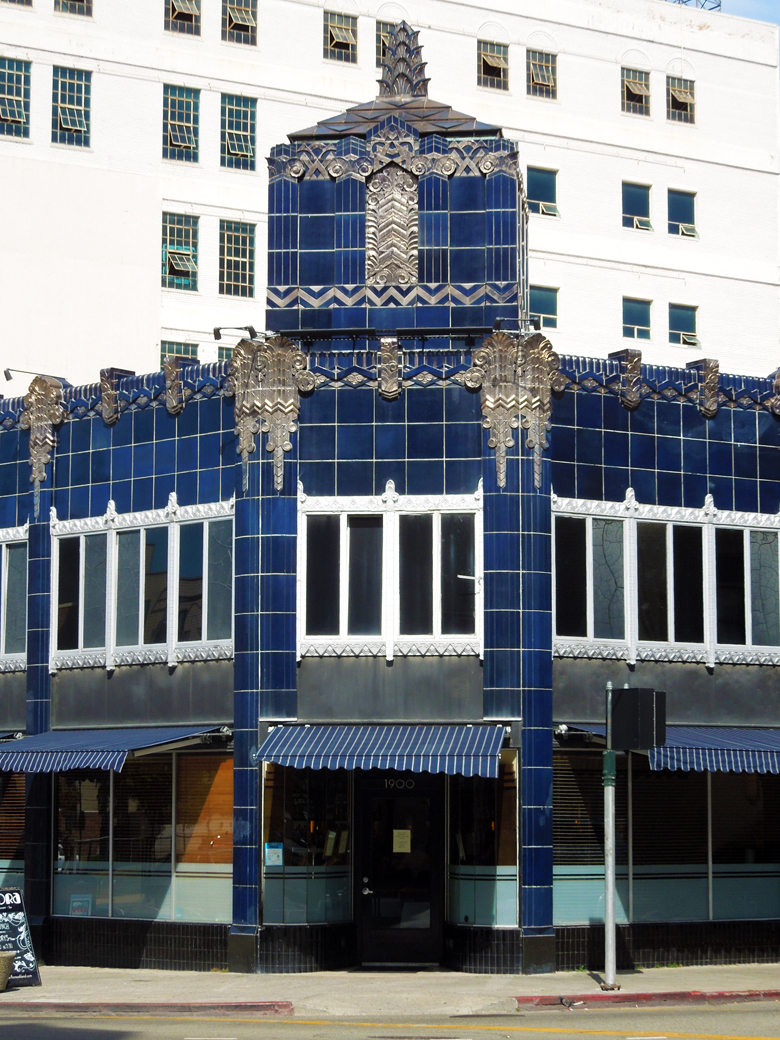
Oakland Floral Depot Building  & Flora Restaurant
The Oakland Floral Depot building houses the restaurant, Flora.


Historic Preservation

When the Loma Prieta earthquake hit Oakland in 1989, there was little financial incentive to demolish damaged buildings and start over. This turned out to be a boon for the beautiful, historic buildings that have been restored. Lack of interest in Uptown properties gave the Oakland Heritage Alliance and the City a chance to figure out ways to save the original buildings or facades. Many of the buildings are designed in the Art Deco style, and faced with glazed terra-cotta.

The City also provides matching grants to businesses in designated areas to renovate their exteriors. Free architectural assistance and 50 percent matching grants of between $10,000 and $30,000 are available to property and business owners for eligible projects.

The Capwell Building
This is a story of anticipated success. After the earthquake damaged the Beaux-Arts style department store, the retrofit included covering the original windows and terra-cotta cladding with concrete. The building that housed Sears since 1996, was purchased by Lane Partners who began renovation last November. The new design promises to bring back the windows and reopen the interior BART entrance. The ground floor will feature restaurants and foodie retail while the 2nd, 3rd and 4th floors are reserved for tech tenants.

Uptown Bike StationBike Station
A Bike Station has opened up near the 19th Street BART entrance. It has free, attended parking for 130 bikes from 7 am to 9 pm on weekdays. They offer bike repair and tune-ups as well as basic bike accessories. If you have too much fun Uptown to ride your bike home, you can leave it overnight for a $5 fee.

17th Street Gateway
The 17th Street entrance to the 19th Street BART station features new artwork inspired by the Oakland Hills, San Francisco Bay, flashy auto paint, and the blue tile of the station. The sculpture, Shifting Topographies, by Dan Corson, is painted with color-shifting paint that changes hue depending on the angle of the sun. At one end of the station, emergency ventilation shafts are disguised with topographic patterns on blue mirrored glass. Shapes of light are projected on the sculpture at night assuring that this a work of art that never stands still.

Never standing still is a good description of the whole Uptown neighborhood: It just keeps getting better.

Click on a photo to start the slideshow.

Berkeley Rocks

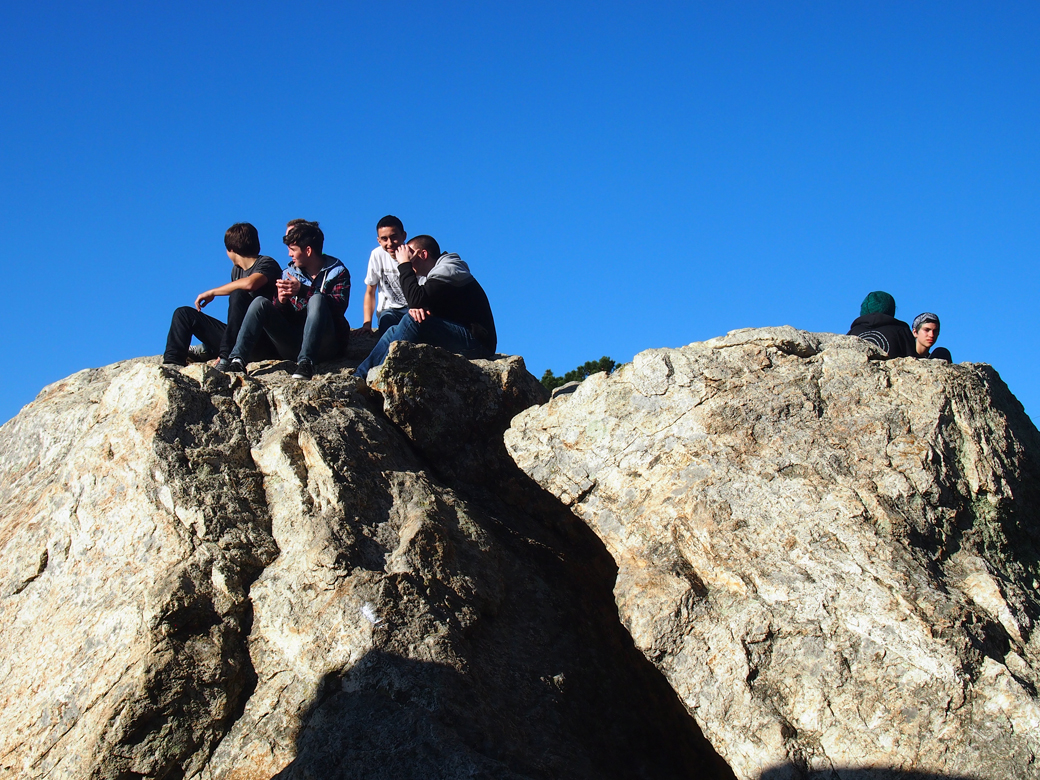
Indian Rock, Berkeley

You really have to see Berkeley’s rocks. Ancient rock outcroppings are not so unusual in California, but the way North Berkeley’s neighborhoods integrated the boulders into the built landscape is pretty awe-inspiring.

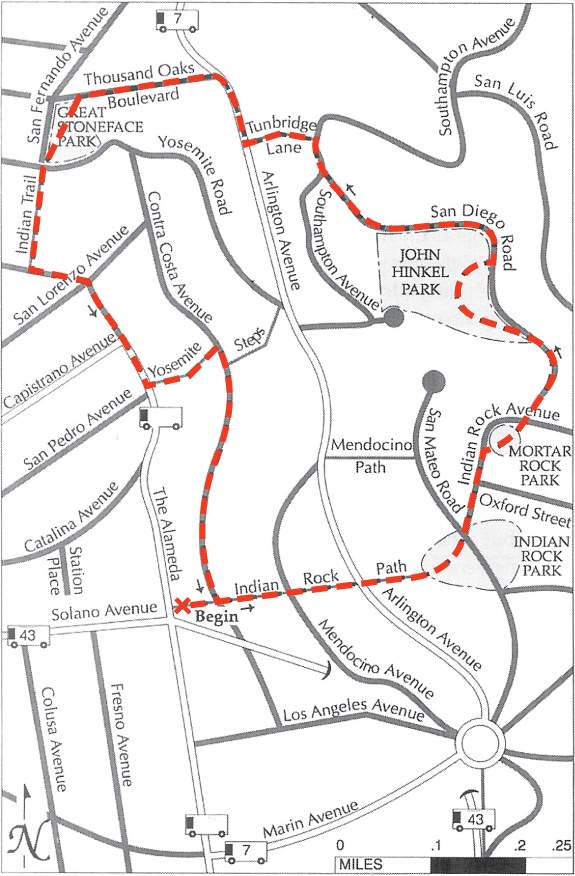
Indian Rocks and Four Parks MapIndian Rock
A few weeks ago, we took another walk featured in Hidden Walks in the East Bay and Marin, by Stephen Altschuler: Indian Rocks and Four Parks. This one’s become a favorite. The walk starts at the northeast corner of The Alameda and Solano Avenue, on the Indian Rock Path. Indian Rock is an ancient volcanic remnant, composed of Northbrae rhyolite. In 1917, the Mason-McDuffie Real Estate Company donated park parcels around five rock formations to the City of Berkeley, including Indian Rock Park.

John Hinkel Park
After passing through Mortar Rock Park, and walking down San Diego Road, we find ourselves in John Hinkel Park. This park always makes me feel nostalgic for a time when parks were places set in nature, places to explore, places to have a woodland adventure. This seven-acre park was donated to the City in 1919 by John and Ada Hinkel. Before donating the park, the Hinkels added a playground, trails, a huge stone fireplace, and a clubhouse, designed by John Gregg. During the depression, the Civil Works Administration built the stone terraced amphitheater, designed by Vernon Dean. It was home to the California Shakespeare Festival from 1934-1991.

The Great Stoneface Park
Our route leads us down residential streets and hidden paths to the aptly named Thousand Oaks neighborhood. All of the neighborhoods through which we pass feature custom Arts & Crafts homes, many designed by famous architects: Bernard Maybeck, Julia Morgan, and Henry Gutterson.

Our next stop is the Great Stoneface Park featuring another massive boulder, an inviting lawn, oak trees, and a handsome concrete urn. When the Thousand Oaks neighborhood was built, about twenty monumental urns, in the style of Maxfield Parrish, were placed along the streets and walking paths. After a hundred years, only one remains, at the base of Indian Trail. The one in the park is a replica commissioned by neighbors who have organized to recreate this stunning and dramatic tradition.

In Harmony with Nature
The Indian Trail is one of the most rustic and lovely of the hidden paths, with its canopy of oak branches and gates leading to the secret gardens of North Berkeley. The fundamental tenet of the Arts and Crafts movement was to build in harmony with nature. The neighborhoods we pass through blend artistically into the existing landscape. The following quote appeared in an article, “California as a Place for Homes” for the July 1915 issue of California Magazine, by Mark Daniels, the landscape architect who helped layout the Thousand Oaks neighborhood and designed many of the parks and paths we’ve enjoyed on this walk:

“Consider a spot upon the slope of the foothills, where the ground is rendered unavailable for agricultural pursuits by the steep inclines or by the frequent outcroppings of rock, but where gnarled oaks spread their distorted branches and serpent-like roots on every hand. Here is an ideal location for landscape architecture.”

Sources:
Hidden Walks in the East Bay & Marin by Stephen Altschuler.
Berkeley Rocks: Building with Nature by Jonathan Chester and Dave Weinstein.
The historic plaques in Indian Rock Park, John Hinkel Park, and the Great Stoneface Park, City of Berkeley.

The Vibe is Still Groovy at the Trident, Sausalito

Trident, Sausalito-interior

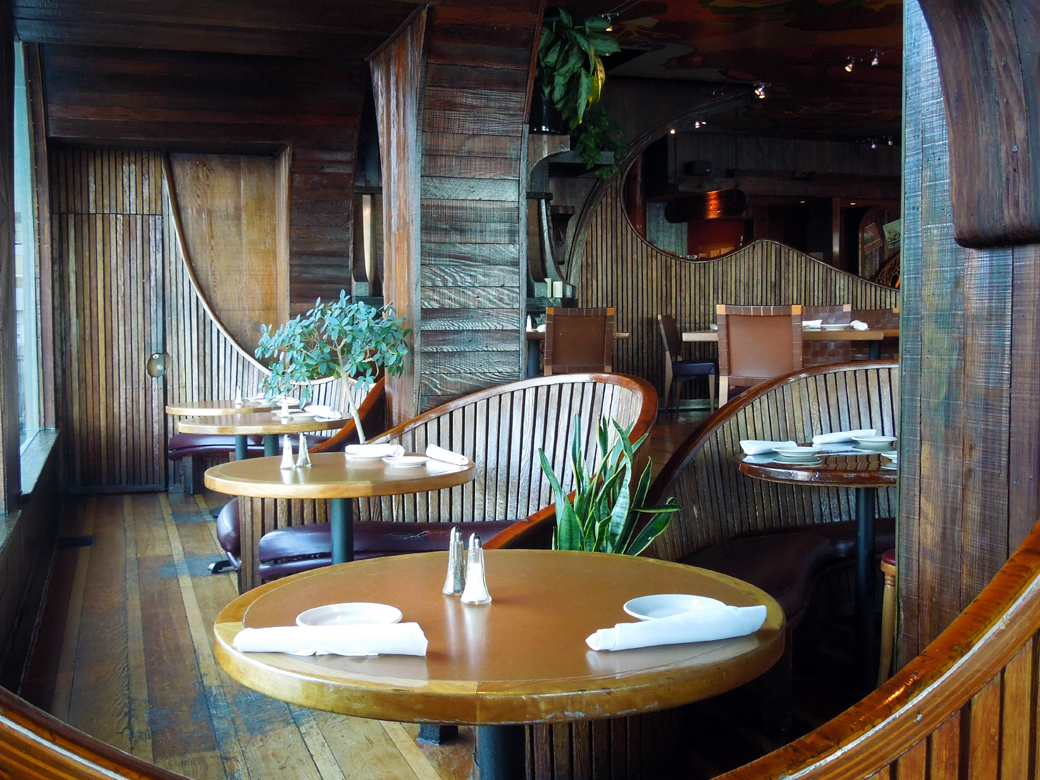
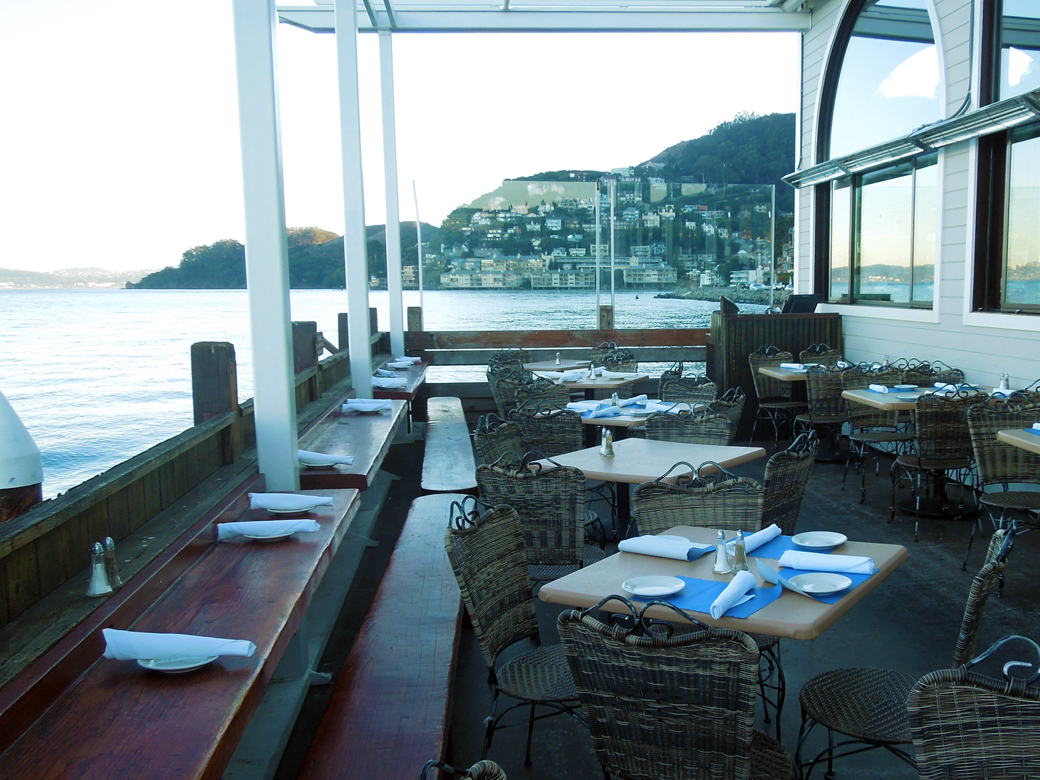
During the 1960s and 70s, you could have bumped into Janis Joplin, enjoyed an impromptu concert by Bob Dylan, or had Robin Williams bus your table at a natural foods restaurant in Sausalito: the Trident. The Kingston Trio [1] bought a bar on the waterfront and opened the Trident Restaurant and music venue in 1960. The owners hired local artisans to create the curvy wooden booths and paint the psychedelic ceiling.

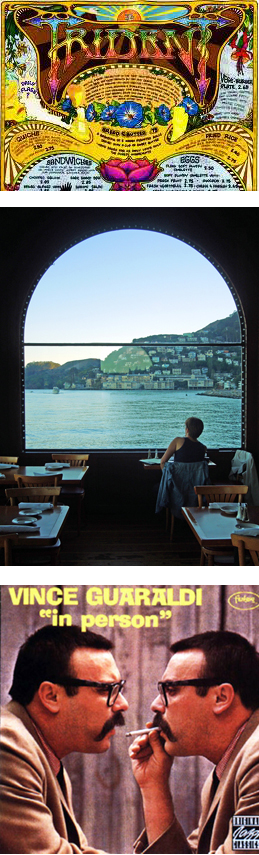
Trident photosThe hippie subculture had found a home.

Some of the stories about the Trident include lovely, scantily dressed, and creative waitresses serving ramos gin fizzes to the likes of Joan Baez, Stephen Stills, Jerry Garcia, Phil Lesh, Groucho Marx, Clint Eastwood, and the Smothers Brothers. A scene from Woody Allen’s, Play it Again Sam was filmed at the restaurant. Janis Joplin had her own table. Vince Guaraldi recorded his live album, In Person, at the Trident. Robin Williams was a busboy. David Crosby dubbed the Trident, “Ground zero for sex, drugs, and Rock and Roll!”

We read Michael Bauer’s review of the recently reopened Trident in Sausalito and knew we wanted to go and get our 60s/70s vibe on. If you’re going, read Michael Bauer’s review to find out what’s worth eating. The woodwork has been restored as well as the ceiling and wall artwork. It’s cool. We appreciated the fact that the reopened Trident features local, organic and sustainably-produced ingredients but most of all, we wanted to commune with Trident’s ghosts and gaze across the San Francisco Bay. We weren’t disappointed.

Do you have any memories of the Trident? Studio 54? No? Then just tell me about the time you tie-dyed a t-shirt at summer camp or drank the kool-aid. I want to know.

1. The Kingston Trio were a hugely popular folk music group in the late 50s and early 60s. My parents listened to their albums.

Sources:

Home

http://www.thetridentrestaurant.com/

http://www.concordmusicgroup.com/artists/vince-guaraldi/

Outdoor patio at the Trident, Sausalito

Whistling Past the Graveyard

141101 Mtn View Cemetery-fall color-web

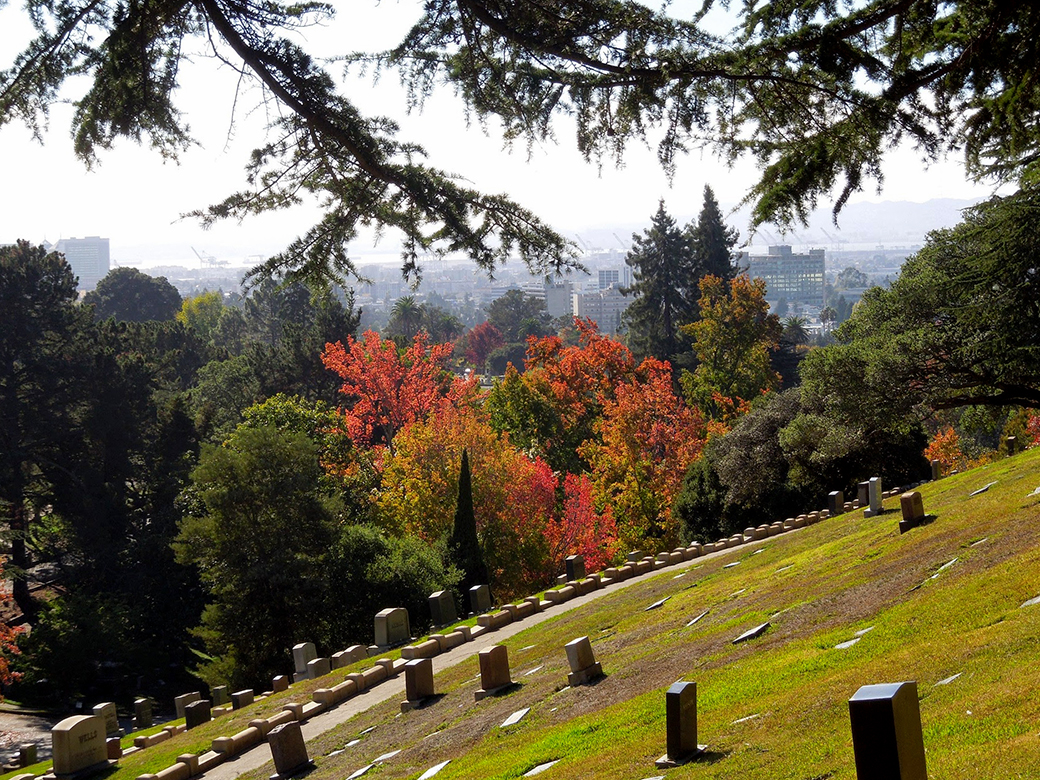
People in Oakland have great places to walk. There’s the East Bay Regional Parks, Lake Merritt, the Bay Trail, Arrowhead Marsh, Joaquin Miller Park, and a bunch of stairway walks through neighborhoods. Still, one of my favorites is Mountain View Cemetery.

After two graveyards impeded Oakland’s early growth, a group of Oaklanders decided to create a cemetery far enough from the center of town, that it would never be in the way. The non-profit Mountain View Cemetery Association was formed and the Board of Trustees began searching for a site. They bought 220 acres of hillside land from Rev. I. H. Brayton who used the proceeds ($13,000) to continue Oakland’s College of California, predecessor to UC Bekeley.

Millionaire's Row
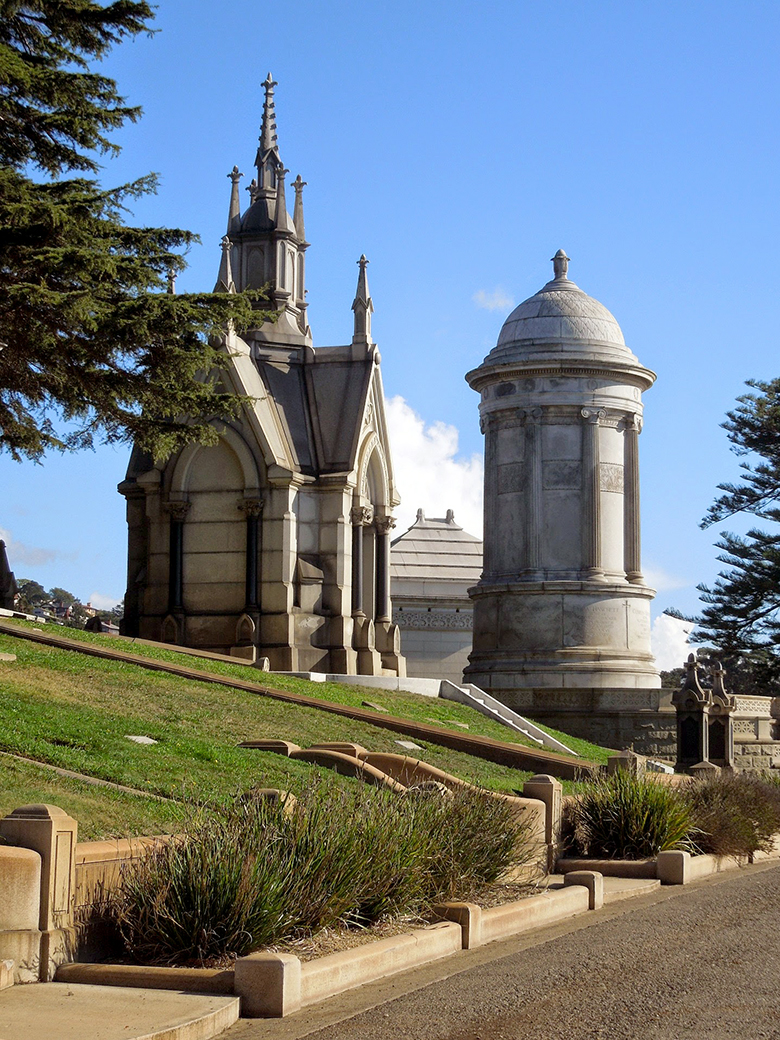
Millionaire’s Row with a view of a Gothic Revival aedicula for Frederick Delger and the vault of Charles Crocker, founder of the Central Pacific Railroad

Frederick Law Olmsted
The cemetery’s designer is the Father of Landscape Architecture, Frederick Law Olmsted. Among the many distinguished places he designed are New York City’s Central Park and the Stanford University Campus. When the original UC Berkeley campus moved from Oakland, he designed the layout. His concept for the Mountain View Cemetery was to create a place that celebrated the works of man while elevating the beauty and peace of nature.

Famous Designers
Many of California’s rich and famous chose Mountain View as their final resting place and created remarkable mausoleums and monuments to celebrate their lives. Architects are rarely rich but Julia Morgan and Bernard Maybeck are famous, and both are interned at Mountain View Cemetery. Morgan is best known for designing the main building at Hearst Castle. She studied under Maybeck at UC Berkeley and designed the Greek Theater on that campus. Maybeck designed many Arts & Crafts buldings in the Bay Area, including the Palace of Fine Arts in San Francisco and the Faculty Club on the UC Berkeley Campus.

I guess it’s no surprise that the beautiful and elegant Mountain View Cemetery shares a relationship with the University in Berkeley. They were designed and built in the East Bay at a time when Californians wanted to demonstrate their civility and good taste to the world. They were fortunate that Frederick Law Olmsted was here to help them out. Both sites have sweeping views, grand boulevards, stunning landmarks, and plenty of hills to keep a seasoned walker in shape.

Sources:
http://www.mountainviewcemetery.org
http://www.oaklandhistory.com/files/hmvc1.html
Beth Bagwell; Oakland: The Story of a City; 2012 Oakland Heritage Alliance