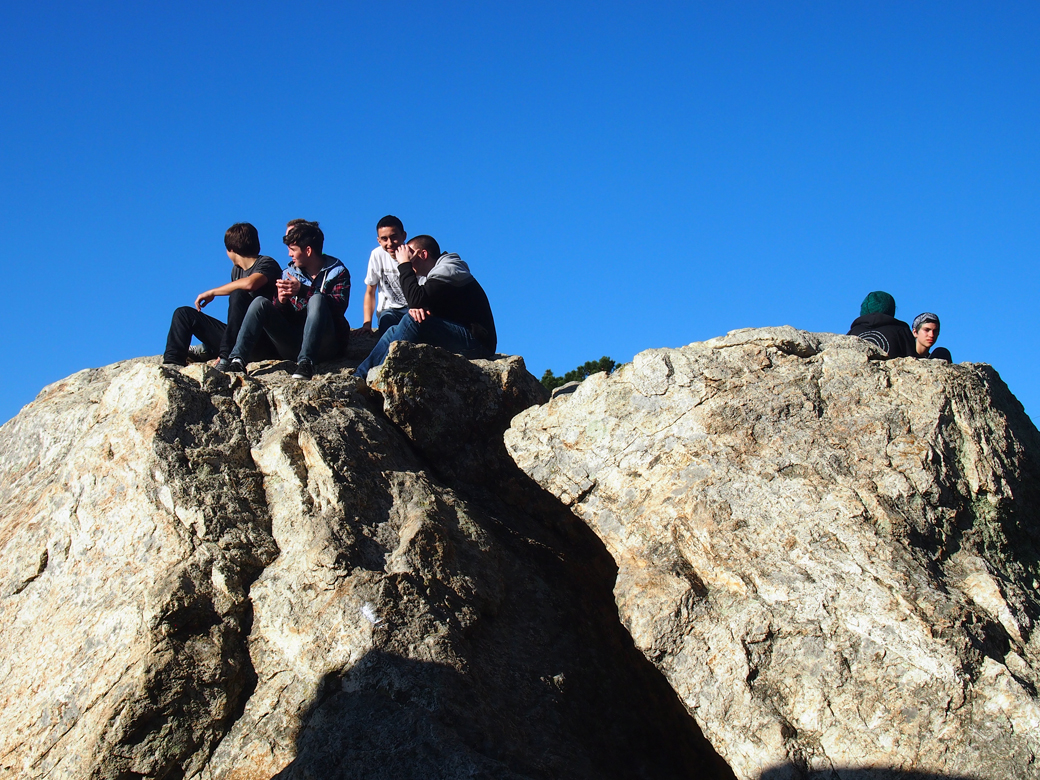
Berkeley Rocks

Indian Rock, Berkeley

You really have to see Berkeley’s rocks. Ancient rock outcroppings are not so unusual in California, but the way North Berkeley’s neighborhoods integrated the boulders into the built landscape is pretty awe-inspiring.
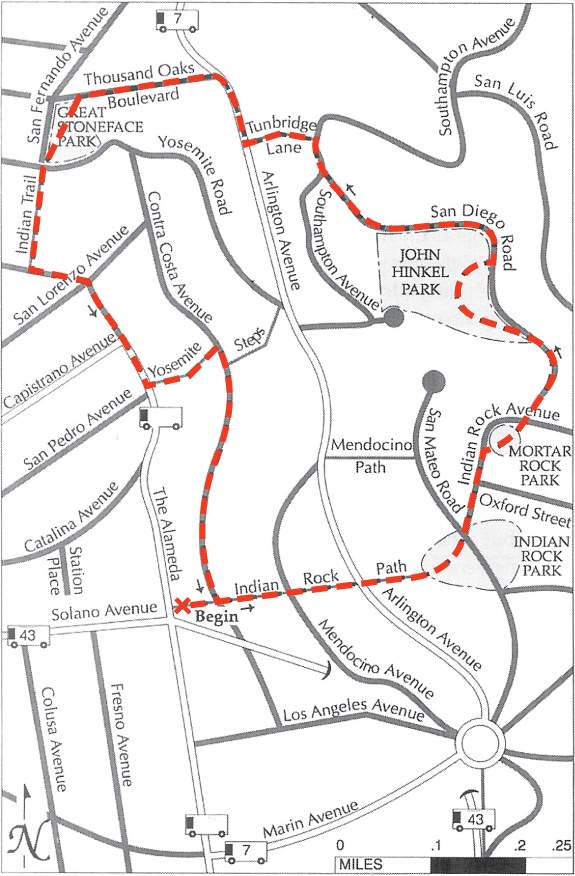
Indian Rocks and Four Parks MapIndian Rock
A few weeks ago, we took another walk featured in Hidden Walks in the East Bay and Marin, by Stephen Altschuler: Indian Rocks and Four Parks. This one’s become a favorite. The walk starts at the northeast corner of The Alameda and Solano Avenue, on the Indian Rock Path. Indian Rock is an ancient volcanic remnant, composed of Northbrae rhyolite. In 1917, the Mason-McDuffie Real Estate Company donated park parcels around five rock formations to the City of Berkeley, including Indian Rock Park.

John Hinkel Park
After passing through Mortar Rock Park, and walking down San Diego Road, we find ourselves in John Hinkel Park. This park always makes me feel nostalgic for a time when parks were places set in nature, places to explore, places to have a woodland adventure. This seven-acre park was donated to the City in 1919 by John and Ada Hinkel. Before donating the park, the Hinkels added a playground, trails, a huge stone fireplace, and a clubhouse, designed by John Gregg. During the depression, the Civil Works Administration built the stone terraced amphitheater, designed by Vernon Dean. It was home to the California Shakespeare Festival from 1934-1991.

The Great Stoneface Park
Our route leads us down residential streets and hidden paths to the aptly named Thousand Oaks neighborhood. All of the neighborhoods through which we pass feature custom Arts & Crafts homes, many designed by famous architects: Bernard Maybeck, Julia Morgan, and Henry Gutterson.

Our next stop is the Great Stoneface Park featuring another massive boulder, an inviting lawn, oak trees, and a handsome concrete urn. When the Thousand Oaks neighborhood was built, about twenty monumental urns, in the style of Maxfield Parrish, were placed along the streets and walking paths. After a hundred years, only one remains, at the base of Indian Trail. The one in the park is a replica commissioned by neighbors who have organized to recreate this stunning and dramatic tradition.

In Harmony with Nature
The Indian Trail is one of the most rustic and lovely of the hidden paths, with its canopy of oak branches and gates leading to the secret gardens of North Berkeley. The fundamental tenet of the Arts and Crafts movement was to build in harmony with nature. The neighborhoods we pass through blend artistically into the existing landscape. The following quote appeared in an article, “California as a Place for Homes” for the July 1915 issue of California Magazine, by Mark Daniels, the landscape architect who helped layout the Thousand Oaks neighborhood and designed many of the parks and paths we’ve enjoyed on this walk:

“Consider a spot upon the slope of the foothills, where the ground is rendered unavailable for agricultural pursuits by the steep inclines or by the frequent outcroppings of rock, but where gnarled oaks spread their distorted branches and serpent-like roots on every hand. Here is an ideal location for landscape architecture.”

Sources:
Hidden Walks in the East Bay & Marin by Stephen Altschuler.
Berkeley Rocks: Building with Nature by Jonathan Chester and Dave Weinstein.
The historic plaques in Indian Rock Park, John Hinkel Park, and the Great Stoneface Park, City of Berkeley.

Art, Anti-Fracking & Asian Food

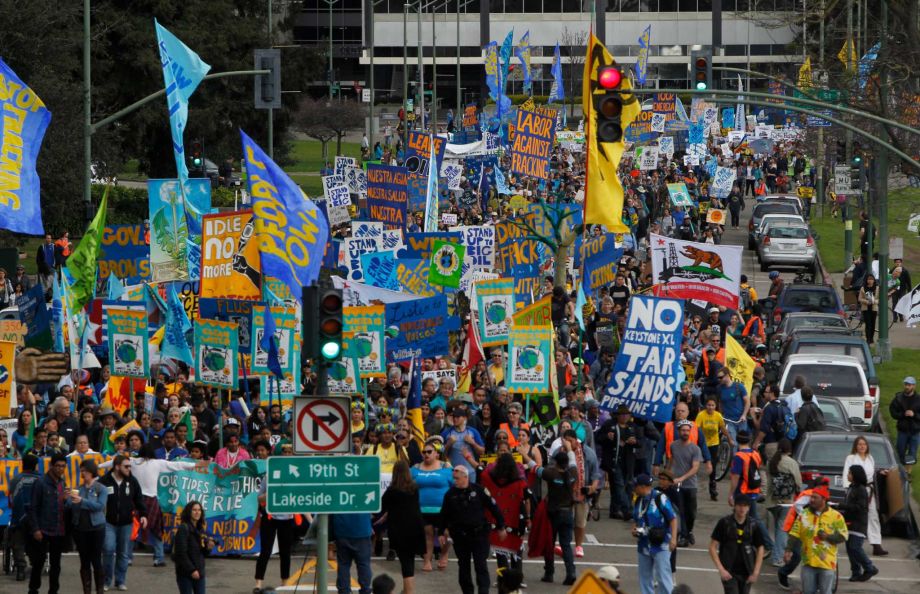
Anti-Fracking DemonstrationDensity, diversity, and being  part of a larger urban context enlivens Oakland and other Bay Area Cities and makes them exciting places to live and visit. Saturday, Jan and I skipped the Grand Lake Farmers Market and chose to walk around the lake, enjoy an exhibit at the museum, and pick up some take-out Asian food for dinner. So what? Even ordinary activities can be extraordinary in a vibrant city.

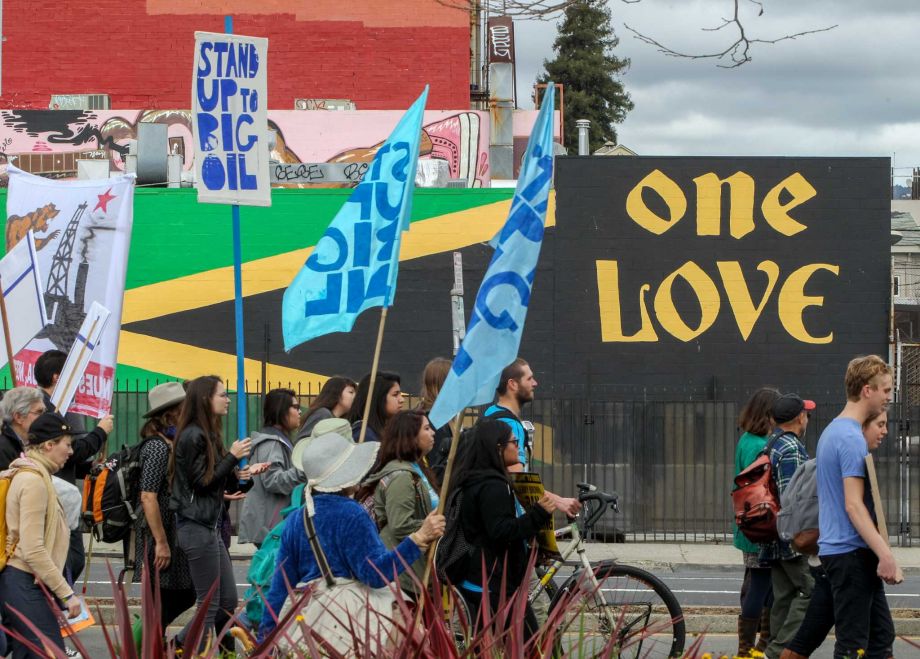
One Love and the activistsIt was raining on and off, and I decided I didn’t really need to bring my camera along. Great idea. There’s never anything interesting going on in Oakland. Remind me to always bring a camera, or a phone, or something with which to shoot a bloody photo.

Anti-Fracking Demonstration
We were about five minutes into the walk when we noticed thousands of demonstrators heading in our direction. Before we could read their banners, Jan remembered that an anti-fracking march was scheduled for Saturday. I know you know what hydraulic fracturing (fracking) is, but I can’t resist describing it: Frackers drill deep into the earth to inject a huge amount of fluid at high enough pressure to fracture subterranean rocks and release oil or natural gas for our consumption. Even without all the facts, does that sound like a good idea? I don’t think so.

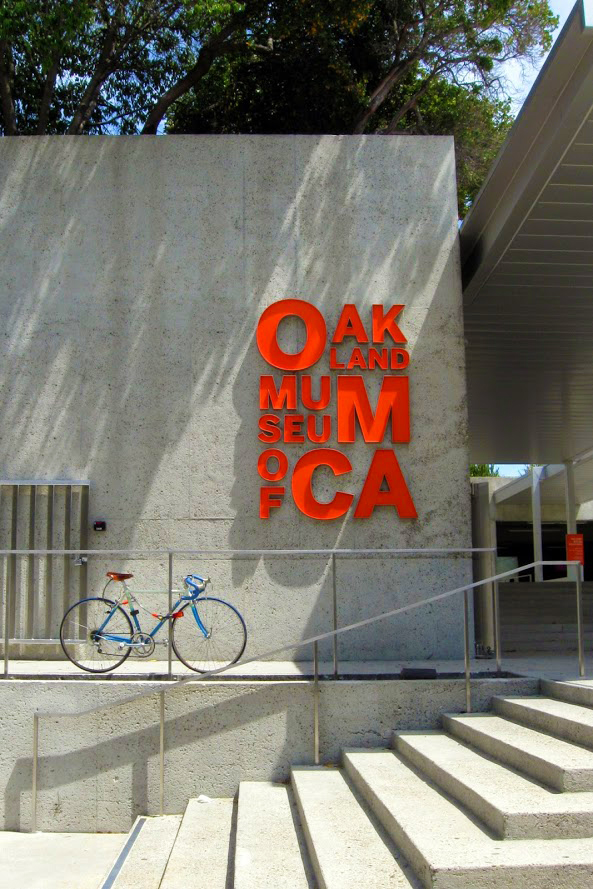
1005220-OMCA-SignThe protest was held in Oakland because Governor Jerry Brown makes his home here and the point of the march was to beseech him to change his policies on fracking. My hypothesis is the demonstration was also held in Oakland because this town is known for being sympathetic to environmental causes and for being able to draw from nearby communities who feel the same. Energized communities have personality.

Oakland Museum of California
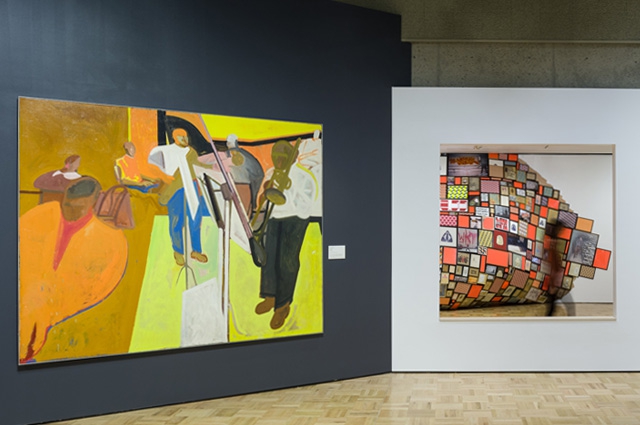
After converging with the crowd at the southern end of the lake, we headed further south to the Oakland Museum of California (OMCA) to check out the exhibit: Fertile Ground: Art and Community in California. Now, I’m one of those oafs who doesn’t like spending more than an hour or so at a time in a museum – but I really like that first hour. That’s one of the reasons a museum membership works for me. We support our local museum and get to stop in whenever we want.

Arnold-FertileGround-2Fertile Ground features the California collections of both SFMOMA (San Francisco Museum of Modern Art) and OMCA. The exhibit guides us through four creative communities active in Northern California from the 1930s to the present:

  • The San Francisco New Deal Muralists lead by Diego Rivera (1930s)
  • Postwar at the California School of Fine Arts (1940s-50s)
  • The New Art Department at UC Davis (1960s-1970s)
  • The Mission Scene (1990s-Today)

It was a stunning and educational hour. The art is rich with diversity and the high-quality venue makes sense in a an urban location that draws users from around the Bay.

lin jiaLin Jia Asian Kitchen
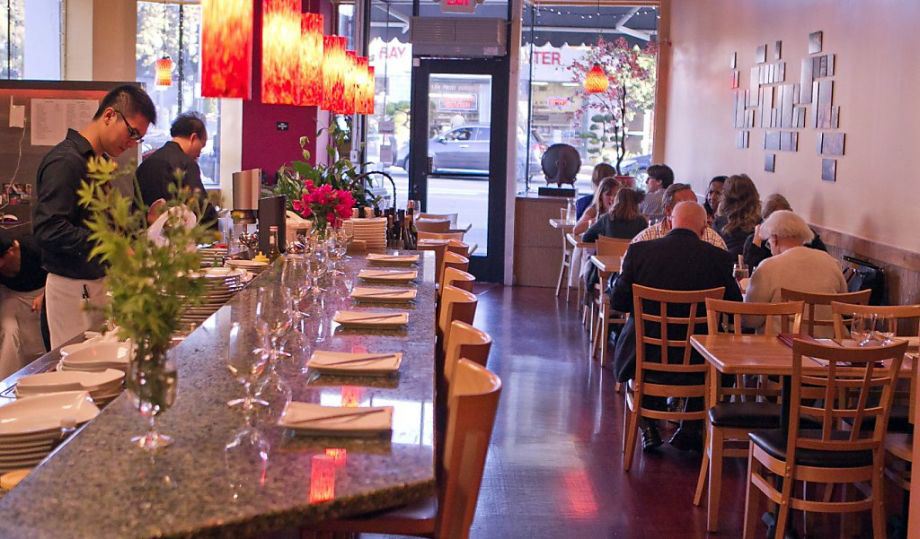
After leaving the museum, we completed our lake loop and ended up on Lakeshore Avenue at Lin Jia Asian Kitchen. You might think it would make sense to call in our order before we arrive at the restaurant, (even though you know I didn’t bring my phone with me – if I did, I could have taken some photos) but that would deprive us of the opportunity to watch the chefs prepare our meal. We like to sit at the bar overlooking the kitchen, order a couple of Tsingtaos when we order the food, and watch the woks in action. We appreciate the high-quality, organic, and sustainable ingredients as well as the excellent preparation. In his review, Michael Bauer describes the experience as, “telling the story of one family’s move from Asia to America.” We’re sure glad they’re here. We’re sure glad we’re here.

As an urban designer, I want to make better places, but some places are lively without help from designers. They evolve into vibrant places with the help of their culturally rich communities. Any thoughts on what makes a great place to live?

Sources:

All of the Anti-Fracking Demonstration photos: http://www.sfgate.com/bayarea/article/Anti-fracking-demonstrators-march-through-Oakland-6068760.php

The Fertile Ground Exhibit photo and background info: http://www.museumca.org/exhibit/fertile-ground-art-and-community-california

The Lin Jia photo and review: http://www.sfgate.com/restaurants/diningout/article/Lin-Jia-Asian-Kitchen-family-s-compelling-journey-2327034.php

Placemaking

Parking Day in Flint, Michigan
Parking Day in Flint, Michigan. Photo from http://www.aiaflint.com/
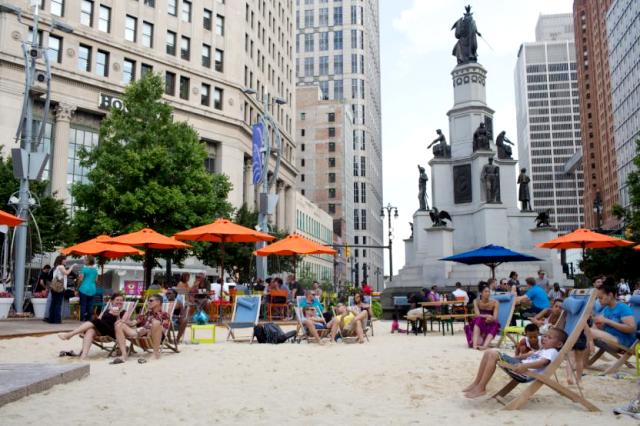
In downtown Detroit, an underutilized lawn was transformed into a beach at Campus Martius Park. Photo from pps.org

I’ve been posting about all things local here in the East Bay. What about you and the place where you live? What do you love about your neighborhood? What would make it even better?

On Friday, I attended the SF Placemaking Summit at AIASF (American Institute of Architects, San Francisco Chapter).The overall idea of placemaking is to create better public spaces: not just better looking, but open space that’s more useable by everybody in the community. Some of the principles are:

  • The community is the expert.
  • Public space should be an authentic reflection of the community.
  • Do little, easy things now and you can improve it if it’s working.
  • Public spaces are for everyone.
  • Each place should have several things to do.
  • Great public spaces are places to connect.

How is that different from good urban design? In my opinion, it isn’t. That may be an effect, in part, of the placemaking movement’s influence on urban design and the inspiration of William H. Whyte. In the 1970s, Whyte set up the Streetlife Project,a pioneering study of how people use spaces. Over the past 30 years, urban designers have learned to incorporate the principles of placemaking in our work.

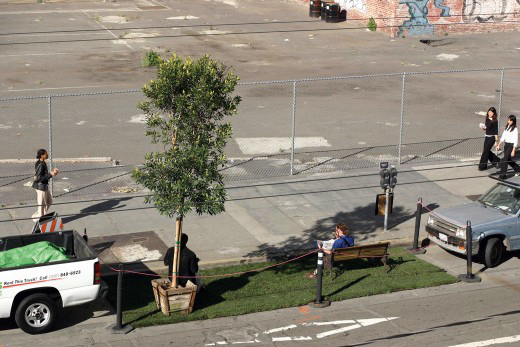
The original PARK(ing) Day park created by Rebar in 2005. Photo from Rebar

An important placemaking concept is a bottom-up approach, and parklets are an example inspired by PARK(ing) Day. Downtown San Francisco is densely populated and built-out with limited room for new public open space, but there’s plenty of space dedicated to the automobile. Rebar, a local art and design studio, started PARK(ing) Day in San Francisco in 2005 by converting a single metered parking space into a temporary public park.The concept was so popular that now PARK(ing) Day is celebrated on the third Friday in September all over the world. Drawing on the success of PARK(ing) Day, the City of SF’s Planning Department adopted a policy for parklets that would last an entire summer or longer: Pavement to Parks. This has been the model for global parking space conversion to useable open space.

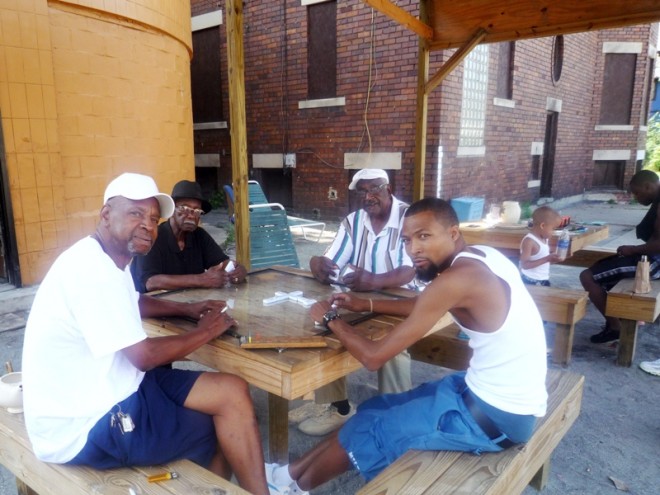
Central Detroit residents have transformed an abandoned gas station into a gathering place at Peaches & Greens, complete with new furniture and a pavilion structure to protect domino players from the elements. / Photo: Steve Davies / Peaches & Greens
Central Detroit residents transformed an abandoned gas station into a gathering place at Peaches & Greens. Photo: Steve Davies/Peaches & Greens

The SF Placemaking Summit was thought-provoking and inspirational. We asked a lot of questions that I’ll explore here in the coming weeks. For example, a lot of the placemaking happening in San Francisco is designed for hipsters. What kind of placemaking is for children or seniors? Are public spaces being created in all neighborhoods?

Parklets are just one way you might be able to create public space in your community. What are some others? Have you been noticing more outdoor places to gather in your town? Let’s start a conversation.

Sources: http://www.pps.org/