Whistling Past the Graveyard

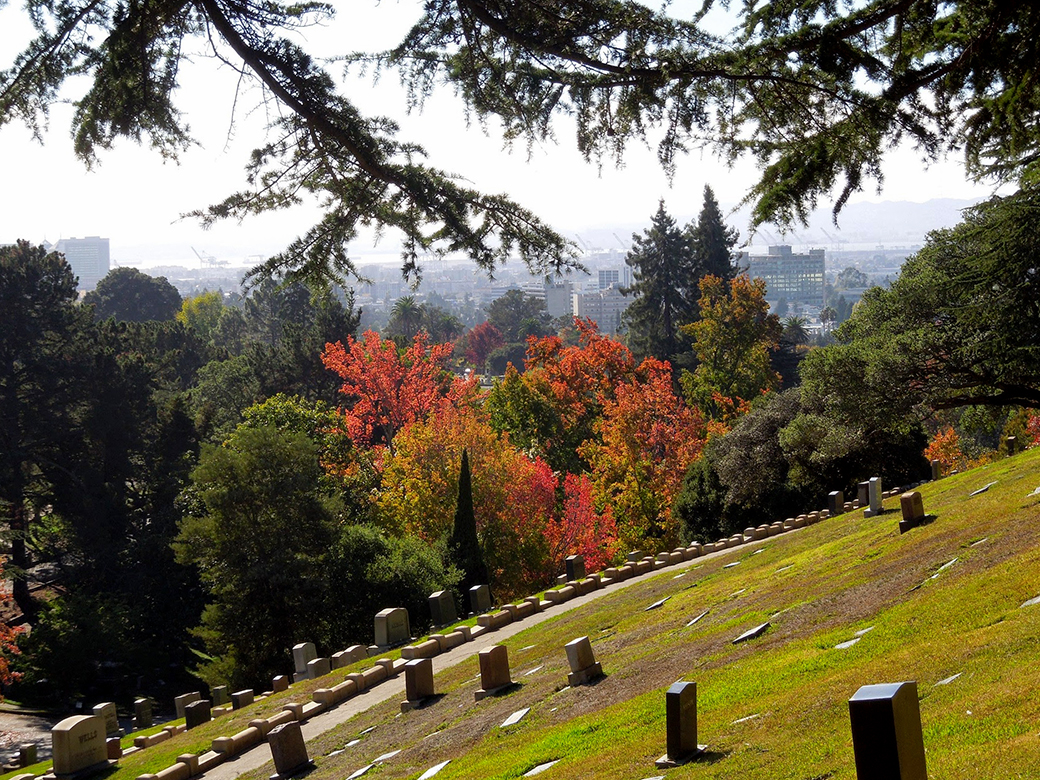
141101 Mtn View Cemetery-fall color-web

People in Oakland have great places to walk. There’s the East Bay Regional Parks, Lake Merritt, the Bay Trail, Arrowhead Marsh, Joaquin Miller Park, and a bunch of stairway walks through neighborhoods. Still, one of my favorites is Mountain View Cemetery.

After two graveyards impeded Oakland’s early growth, a group of Oaklanders decided to create a cemetery far enough from the center of town, that it would never be in the way. The non-profit Mountain View Cemetery Association was formed and the Board of Trustees began searching for a site. They bought 220 acres of hillside land from Rev. I. H. Brayton who used the proceeds ($13,000) to continue Oakland’s College of California, predecessor to UC Bekeley.
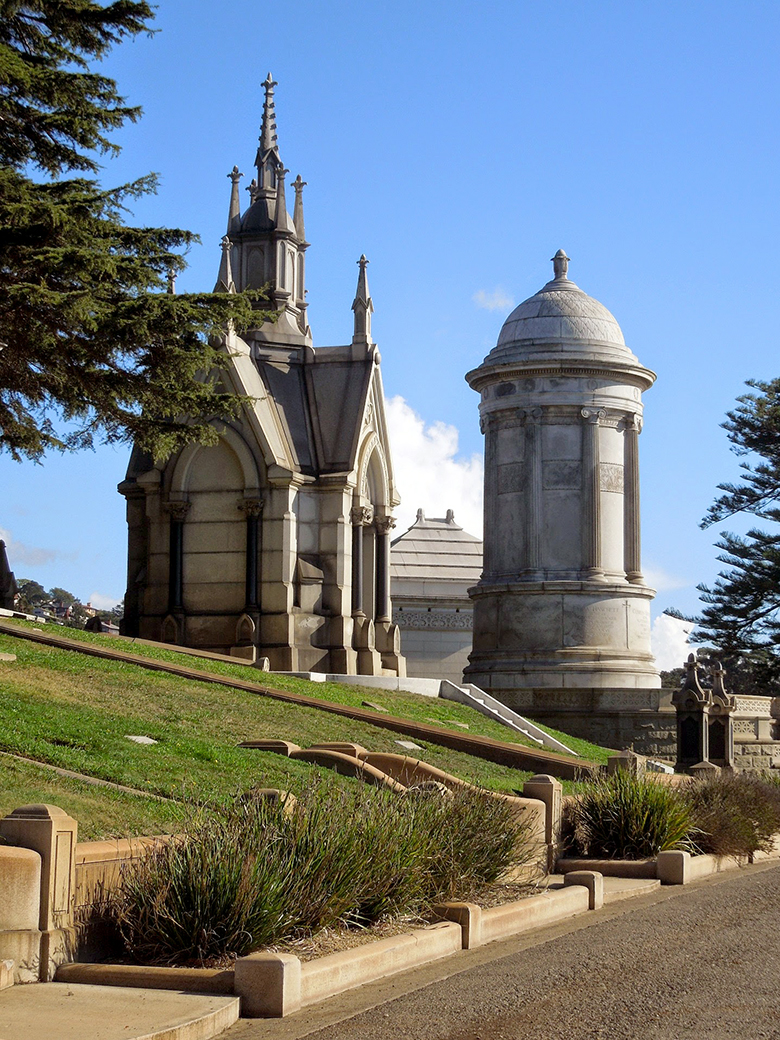
Millionaire's Row
Millionaire’s Row with a view of a Gothic Revival aedicula for Frederick Delger and the vault of Charles Crocker, founder of the Central Pacific Railroad

Frederick Law Olmsted
The cemetery’s designer is the Father of Landscape Architecture, Frederick Law Olmsted. Among the many distinguished places he designed are New York City’s Central Park and the Stanford University Campus. When the original UC Berkeley campus moved from Oakland, he designed the layout. His concept for the Mountain View Cemetery was to create a place that celebrated the works of man while elevating the beauty and peace of nature.

Famous Designers
Many of California’s rich and famous chose Mountain View as their final resting place and created remarkable mausoleums and monuments to celebrate their lives. Architects are rarely rich but Julia Morgan and Bernard Maybeck are famous, and both are interned at Mountain View Cemetery. Morgan is best known for designing the main building at Hearst Castle. She studied under Maybeck at UC Berkeley and designed the Greek Theater on that campus. Maybeck designed many Arts & Crafts buldings in the Bay Area, including the Palace of Fine Arts in San Francisco and the Faculty Club on the UC Berkeley Campus.

I guess it’s no surprise that the beautiful and elegant Mountain View Cemetery shares a relationship with the University in Berkeley. They were designed and built in the East Bay at a time when Californians wanted to demonstrate their civility and good taste to the world. They were fortunate that Frederick Law Olmsted was here to help them out. Both sites have sweeping views, grand boulevards, stunning landmarks, and plenty of hills to keep a seasoned walker in shape.

Sources:
http://www.mountainviewcemetery.org
http://www.oaklandhistory.com/files/hmvc1.html
Beth Bagwell; Oakland: The Story of a City; 2012 Oakland Heritage Alliance

Living Local: Our Own Backyard

New Steps from Above

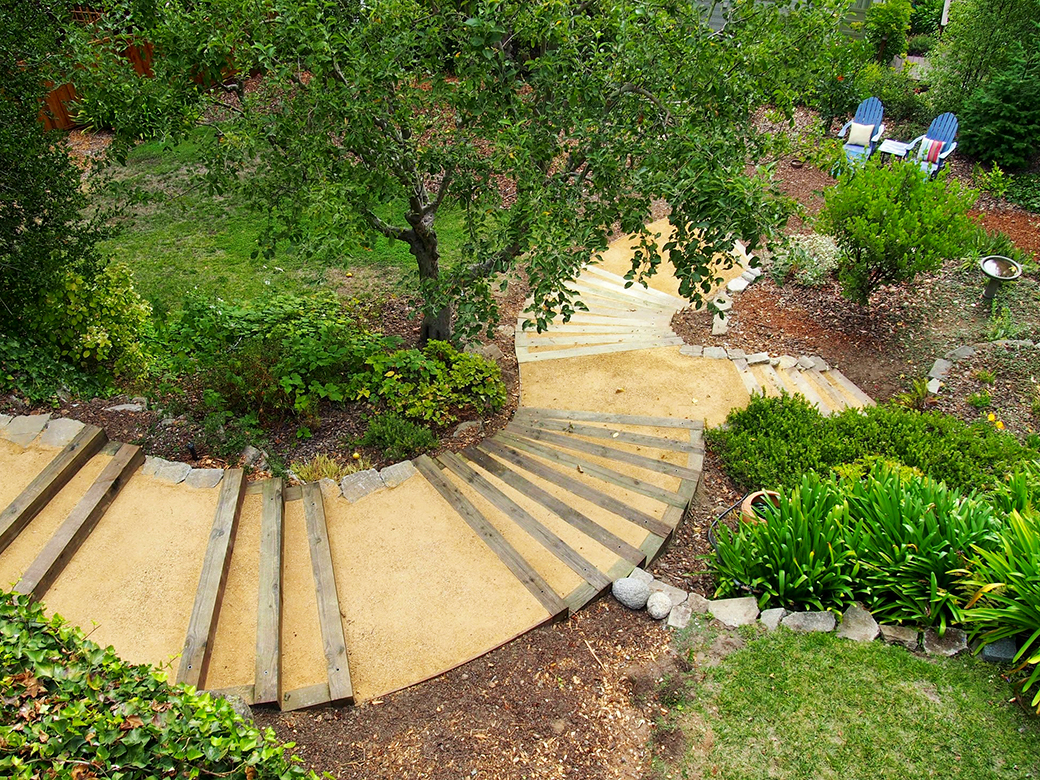
There’s no place more local than your own backyard. We’re outdoorsy gals and we spend a lot of time both working and relaxing in our yard. When we bought the house, the steep path down to the garden started with wooden steps, leading to a concrete ramp, followed by haphazardly arranged railroad-tie steps, and then a short bare incline to the level terrace at the foot of the slope. It was kind of a mish-mash jumble that we first thought was charmingly rustic and later, well, not so charming.

We have a lot of dreams for our yard, but like most people, we have limited funds so we have to carefully pick and choose what we take on and when. Since the steps are the gateway to our favorite outdoor room, we decided it would be this year’s backyard project.

Before: The original path to the backyard was a steep and uneven mix of ramps, railroad ties, urbanite, and bare slopes.
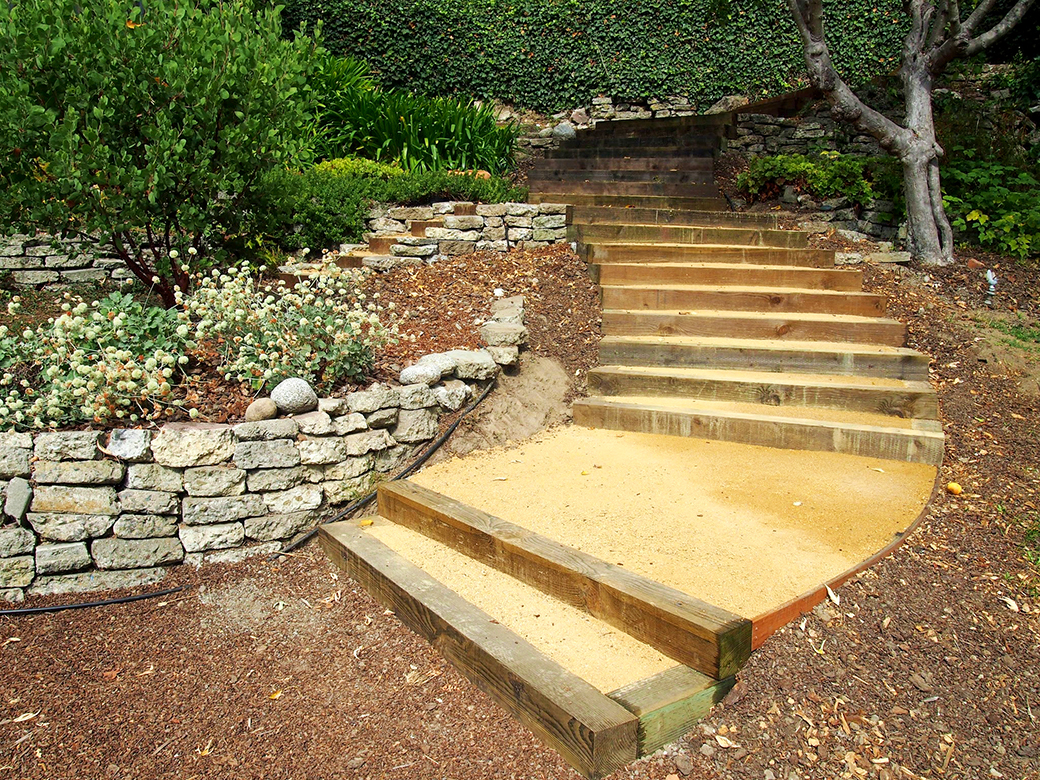
After: The new walkway from our home to the garden is composed of six-foot wide curving steps and level landings. It's astounding how much more of a pleasure it is to walk on a well-designed and built set of steps.
After: The new walkway from our home to the garden is composed of six-foot wide curving steps and level landings. It’s astounding how much more pleasurable it is to walk on a well-designed and built set of steps.

Design/Build
We hired Four Dimensions Landscape Company in Oakland to design and build the steps and we couldn’t be happier with our experience. First, they designed the striking “S” curve on paper, knowing adjustments might be made in the field. The integrated process of design/build makes for a smooth and efficient transition from paper to earth. You wouldn’t want a contractor who doesn’t appreciate design enough to make smart decisions during construction.

When it came time to put the steps in the ground, Michael Thilgen, one of the Company’s owners and a licensed landscape architect, spent hours on-site with a transit and the construction crew. He made sure the steps are comfortable to traverse with landings at the locations where we want future paths to connect. At the same time, he never lost sight of that sinuous line that makes these the steps of our dreams.

Sustainability
The new steps are constructed of landscape timbers, decomposed granite, and existing urbanite (recycled concrete) we had on site. The decomposed granite is permeable for improved storm water infiltration. The original railroad-ties will be reused to make a retaining wall in another part of our yard. Now we spend even more time in the backyard, sprucing it up to be worthy of the new steps.

Have you been working on any projects close to home?

Puttin’ On the Ritz

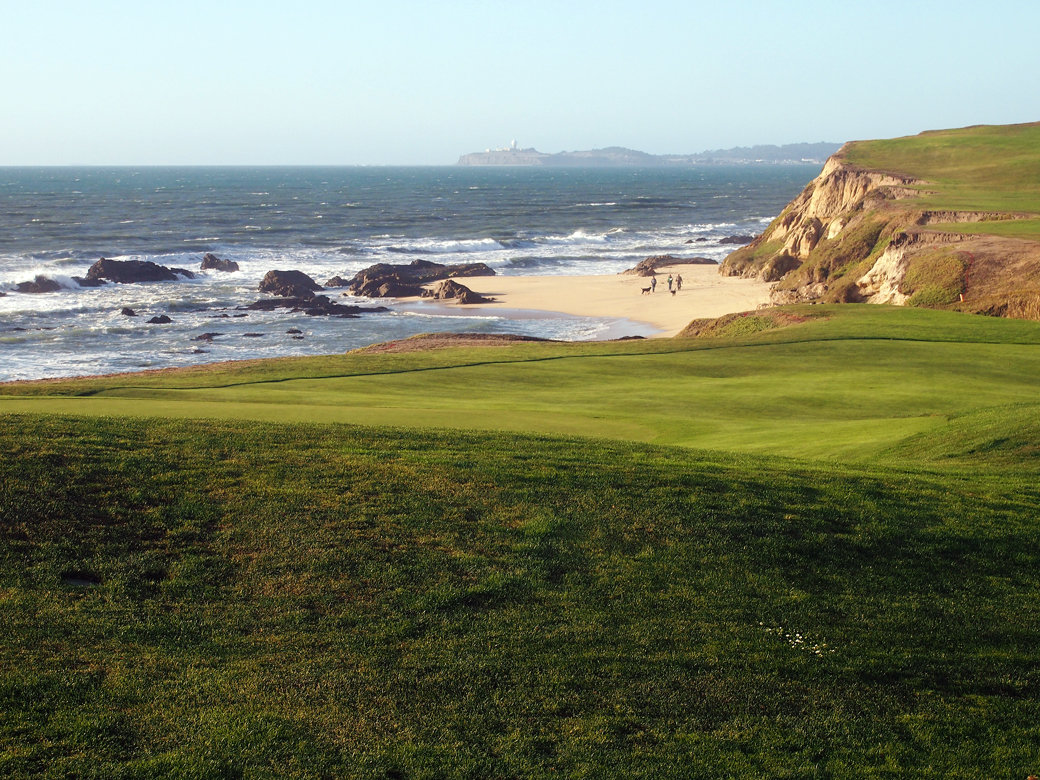
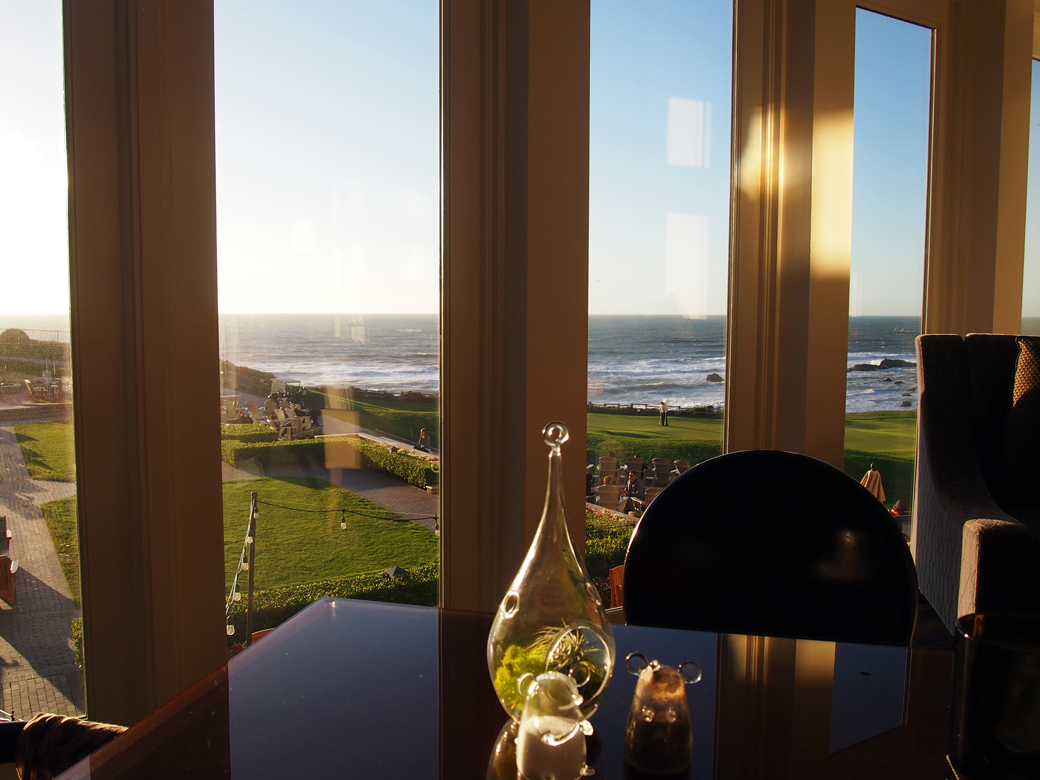
View from Ritz Carlton Half Moon Bay

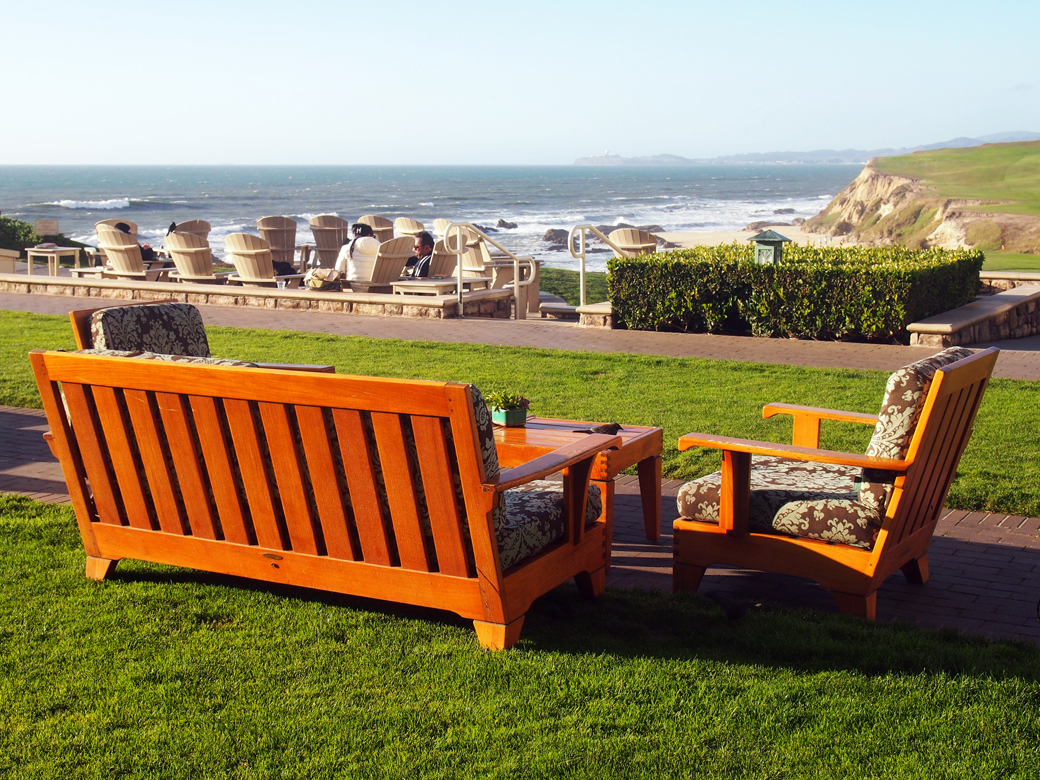
After a spectacular day on the coast, we decided to stop at the Ritz Carlton in Half Moon Bay to enjoy the sunset and a cocktail. Upon arrival, we paid $10 for valet parking, the only option, and headed directly for the ocean terrace by the fire pits. We had Manhattans that cost an astounding $17.50. Each. And they were worth it – not because they were particularly special but because of the view. Let’s talk about the view.

The squashes at the resort entrance were one seasonal touch that fit with the locale
Photo by the Athens Group

The Ritz Carlton is everything I don’t like and yet, I liked it. It’s a bit of Scotland on the California coast…because we need California to be Scotland? No. So, the resort features Scottish architecture? No. The hotel is an imposing, shingle style, turreted affair that’s supposed to “evoke the magnificence of 19th century seaside lodges”. Northeastern seaside lodges. The Hamptons come to mind. Okay, it’s a magnificent northeastern style seaside lodge set within a pair of Scottish golf courses with staff walking around in plaid knickers. The Ritz Carlton is not an example of regional design.

Why did I like it? I’ve spent a lot of time on the California coast and the beautiful view from the cliffs overlooking the ocean is never diminished. It can be foggy (and it probably will be), it can be windy, it can smell like the brussels sprouts growing on the bluffs, the beaches can be littered with brown seaweed covered in sand flies, and it is still the most breathtaking place I’ve ever been. The California coast is like a beautiful girl, hair tangled, barefoot in sandy jeans and a faded sweatshirt. The view from the Ritz Carlton ocean terrace on a clear day was like seeing her in a green velvet gown and high heels. It’s not the way I want the coast to be but I can’t help feeling glad I saw her that way.

Ritz Carlton HMB Ocean TerraceRitz Carlton HMB NavioAfter shaking off the sticker shock of the cocktails, we sallied forth to Navio, the restaurant at the resort, with a plan NOT to eat barely acceptable food at very expensive prices. The dining room is lovely and we were given a table at the window. We ordered conservatively, (two women can get away with significantly less food than a traditional couple) and ate a perfectly acceptable dinner for under $100. The service was good. The food was good. Nothing was memorable but the view. After we got back to Oaktown, I checked out Michael Bauer’s 2013 review and can say I think Navio has improved since his meal, but I won’t deny that the restaurant is not a good value.

The Ritz Carlton made me feel sorry for people who think the coastal experience is something they can buy. Without a deeper relationship with the shoreline, the Ritz Carlton is nothing but a fancy, out of place resort. Next time, we might still stop in for a cocktail at the Ritz, but afterwards we’ll head up Highway 1 to our favorite Half Moon Bay taqueria for dinner.

Devil’s Slide, Mavericks & Coastal Geology

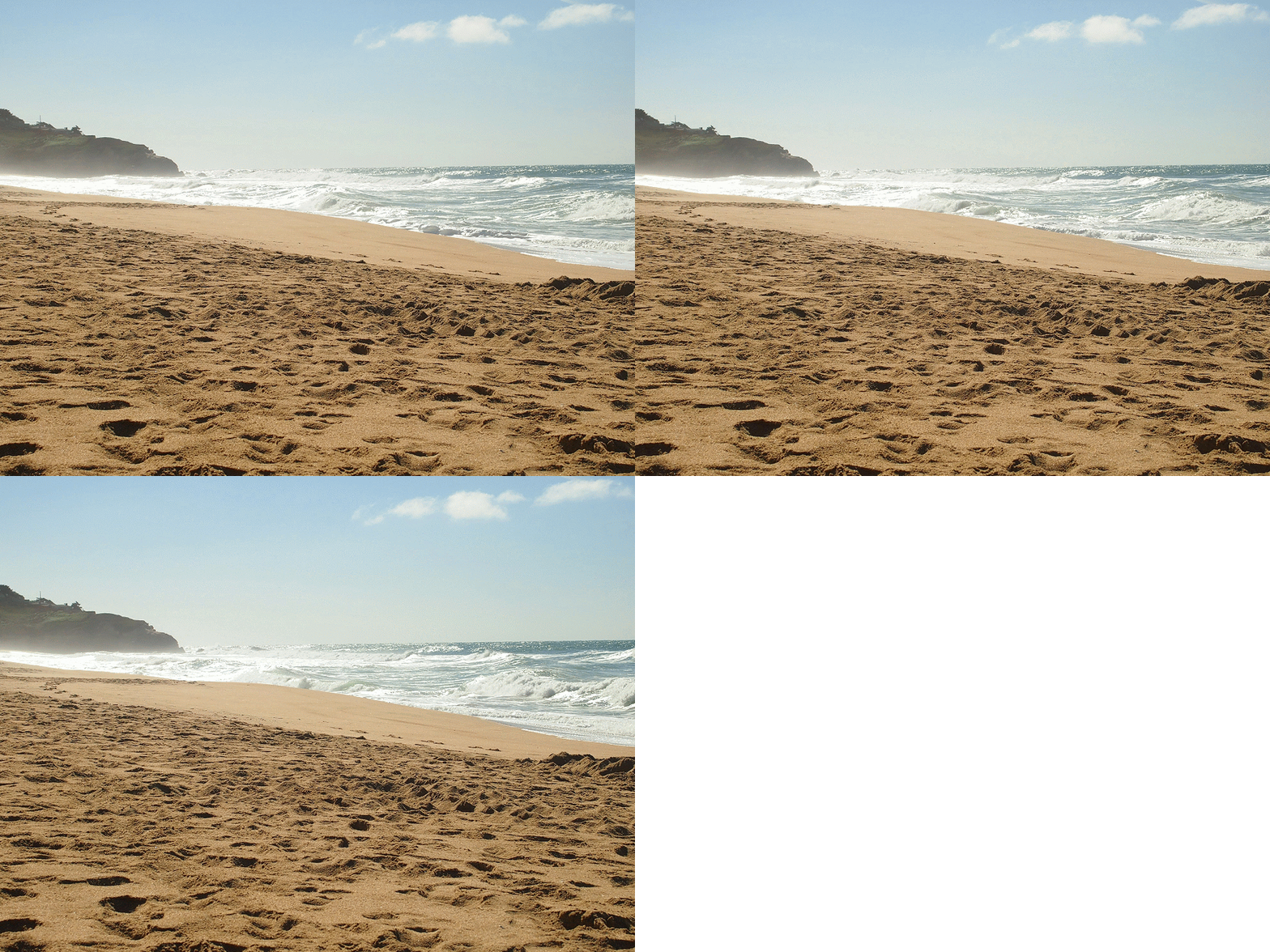
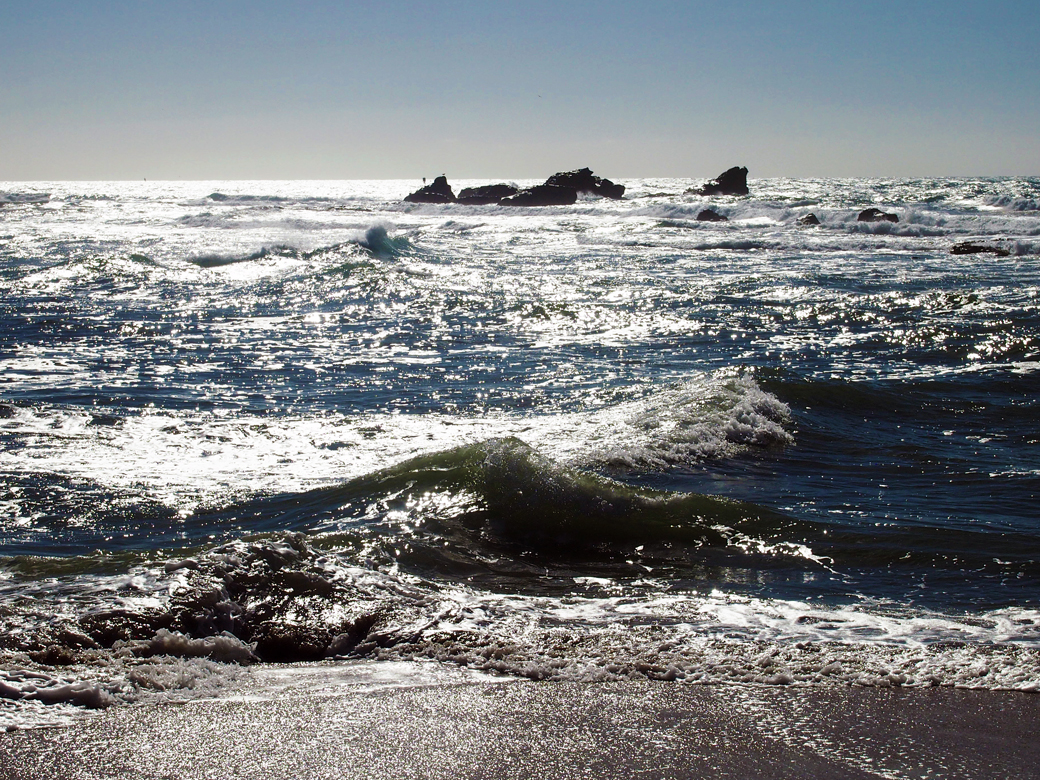
Surf and sand at Montara State Beach

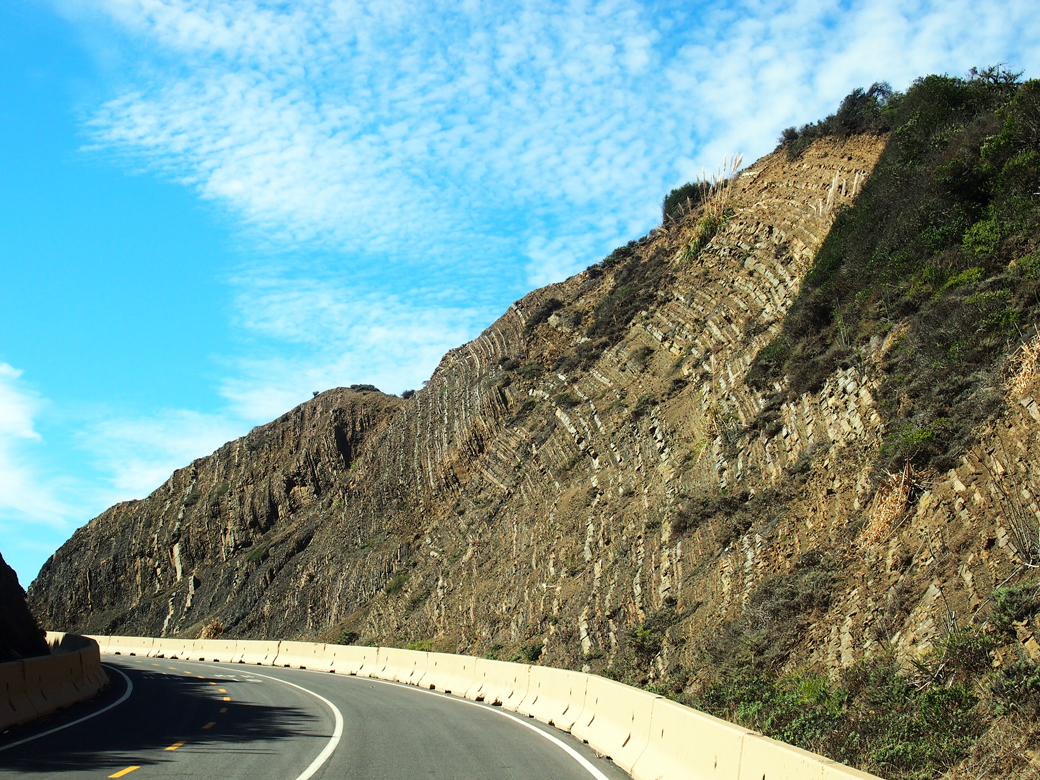
Devil's Slide - Sedimentary layers of shale and sandstone
From Devil’s Slide Trail, we can see sedimentary layers of shale and sandstone thrust up from the ocean floor.

We love going places! In an attempt to reduce our carbon footprint, we spend a lot of our free time traveling local. That doesn’t mean we never fly, but it’s remarkable how much you can learn by visiting places close to home.

Devil’s Slide Trail
This new open space was the first stop on our fall day trip to the coast. Over the years, we’ve been aware of the hellish landslides at this location, sometimes closing Highway 1 for months at a time. On this journey, we learned the area’s geology is the devil causing the slides.

At the north end of the trail are rough sedimentary layers of shale and sandstone that were once part of the ocean floor. At the south end, the cliffs are granitic rock of Montara Mountain. At Devil’s Slide, landslides occur where sedimentary layers were thrust over the granitic rock.

As a result of the landslides, Highway 1 was diverted through the Tom Lantos Tunnels in 2013 and the old highway was converted to this multi-use trail. The views from Devil’s Slide Trail are spectacular but the 1.3-mile walk leads only from parking lot to parking lot. It is a part of the California Coastal Trail and we’re looking forward to the day when it extends from Oregon to Mexico.

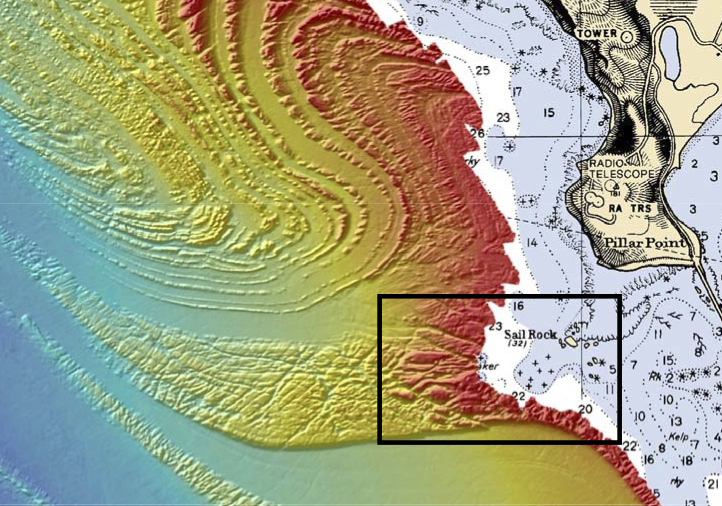
This Seafloor Map released by the US National Oceanic and Atmospheric Administration shows the geology behind Mavericks.
Sail Rock from the beach at Pillar Point
Sail Rock as seen from Mavericks Beach at Pillar Point. Mavericks break is about 2 miles from shore, beyond the visible reef.

Mavericks
Geology plays an important role in another coastal site we visited: Pillar Point, site of the famous M
avericks break. Gradual ramping of the sea-floor, plus deeper water on both sides of the ramp are the key ingredients for the magnificent and sometimes malevolent waves.

Here’s my understanding of how this works: As a wave approaches the shore, its base slows as it runs along the rising seafloor while the top of the wave maintains its original speed. This causes the wave to stand up and pitch forward. The long, gradual slope at Mavericks creates an exceptionally tall wave. The wave continues at full speed at the deeper waters on each side of the ramp, allowing the wave to draw additional energy, and creating a wave convergence at the center of the ramp. After winter storms, waves at Mavericks can top out at over 80 feet. 

The mild fall weather during our day trip produced little surf but it was a beautiful and adventure-filled day. We walked along Cowell Ranch Beach before stopping at the Ritz Carlton Half Moon Bay for dinner. I’ll tell you what we thought about that, next week.

Sources:
Devil’s Slide Brochure from San Mateo County Parks
Mavericks, California from Wikipedia
Map Reveals Secret of Awesome Mavericks Waves by Phil McKenna from New Scientist

What is one of your favorite local places to go?